Translate

Showing posts with label The Snowbirds. Show all posts

Thursday, November 29, 2018

Saskatchewan Airshow Returning After 14 Year Hiatus

By: David Baxter, Global News 

Military pilots from across Canada, and NATO allies have been earning their wings just south of Moose Jaw for over 75 years. To celebrate the aviation and military tradition, 15 Wing Moose Jaw will bring back the Saskatchewan Airshow.
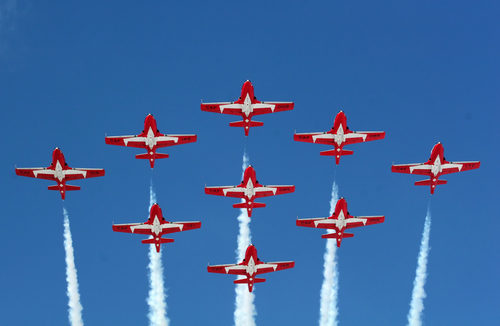
Image result for Saskatchewan Airshow
The Canadian Forces Snowbirds will be a main attraction at the returning Saskatchewan Airshow in 2019. The Airshow will take place at their home base of 15 Wing Moose Jaw. 
Originally discontinued in 2005, the airshow will once again take place on July 6 and 7, 2019.

Wing commander for the base Col. Denis O’Reilly was central in bringing back the airshow. The Moose Jaw native said he wanted to inspire a new generation of pilots.

“My parents had a farm just off the end of the runway and I used to bike out the airport in the summertime, grab a coke and help the pilots wash their aircraft and maybe hope to get a flight,” O’Reilly said.

Growing up in Moose Jaw’s South Hill neighbourhood, O’Reilly routinely heard Snowbirds and other aircraft flying overhead.

“I just grew up hearing that noise all the time and just looking up in the sky and thinking that’s something really cool men and women get to do and that’s something I’ll probably never get to do, not really realizing it’s something available to all Canadians,” O’Reilly said.

Today, one of those “really cool men” is Lt-Col. Mike French, commanding officer for the Snowbirds. Like O’Reilly, his aviation dreams began when he was a three-year-old at an airshow in Abbostford, B.C.

“I saw the Snowbirds flyover. I came out from under my blanket because the RAF Vulcan Bomber flew over and scarred me,” French said. “I came out from under my blanket and looked and saw the Snowbirds flying and decided right then and there that’s what I wanted to do.”

Image result for Avro Vulcan
The Avro Vulcan bomber which flew at the 1977 Canadian International Saskatchewan Airshow. Today, the only remaining flight worthy Vulcan only tours the UK. 
French used to fly in the Saskatchewan Airshow prior to its cancellation. Now, he said the Snowbirds will be midway through their season when the July return comes around, making for a well-rehearsed show.

Formation flying can look seamless from the ground. Up in the air, French compared it to driving in bumper to bumper traffic at 300 miles per hour with vehicles beside, above and below you. That means pilots only have a about a two foot box to maneuver their planes in, leaving no room for error.

“What that means is a lot more room for trust, and we absolutely have to trust each other. We hold ourselves accountable to each other and we can’t break that trust; plain and simple,” French said.

There is still a lot of prep work that will have to go into the airshow’s big return. Organizers anticipate more than 30,000 people will attend the weekend shows.

Military and civilian performers will be announced next year.

In addition to flight demonstrations there will be opportunities to get up close and personal with planes, a cabaret and a Saskatchewan micro-brewery will be chosen to brew a signature beer for the event.

Wednesday, May 16, 2018

Snowbirds and A-10 to Highlight Anderson Airshow

By: Charles Atkeison, AvGeekery Blog

ANDERSON, SC — America’s Air Force A-10 Thunderbolt and Canada’s Air Force Snowbirds are a few of the top performers at the Bill and Jo Trent Anderson Regional Air show this weekend as they help bring the thrust and excitement to upper South Carolina.

he Canadian Royal Air Force Snowbirds will perform above Anderson, S.C. this weekend. (RCAF)
The U.S. Army paratroopers known as the Black Daggers, the A-10 nicknamed the Warthog, and aerobatic pilots Scott Francis in his MXS aircraft and Clemens Kuhlig aboard his award winning Pitts S1S, will perform during the two-day show on May 19 and 20. On Saturday, the U.S. will observe Armed Forces Day.
The Air Force A-10C Warthog will demonstrate low and high speed maneuvers this weekend. (Atkeison)
“The Bill and Jo Trent Anderson Regional Airshow is unique in that it is a totally free airshow — free parking and free admission,” Butch Jones, Anderson Regional Air show director of operations said on Monday. “There will be plenty of food and drinks, a kids zone, vendors of all types, helicopter rides, Stearman rides all set in a family friendly environment.”

The pilots of the Canadian Snowbirds perform in Canadian-built C-114 Tutors jets which provide an individual thrust of 2,700 pounds. During a show, the guests will see the squadron perform with seven or nine jets in a close formation flight demonstration.

This weekend will mark the Snowbirds third appearance at Anderson. “This appearance is special in that they called us and asked us if they could come back,” Jones added. “Our reputation for a class airshow, family environment, and southern hospitality was not forgotten.”

The Anderson air show will mark the Snowbirds third show of their 47th anniversary season. These warriors of the air are a crowd favorite during each event they attend performing tight aerobatic maneuvers performed by Canada’s own Air Force.

“The Snowbirds’ show is the result of six months of intensive preparation and training and consists of over fifty different formations and maneuvers,” Snowbirds spokesperson LT Michèle Tremblay said. “Serving as Canadian ambassadors, the Snowbirds demonstrate the skill, professionalism, and teamwork inherent in the women and men of the Royal Canadian Air Force and the Canadian Armed Forces.”

Clemens Kuhlig is known across the growing air show community as ChefPitts. The name he describes as a combination of his two favorite hobbies — cooking and flying. As he spent three years building his Pitts S1S, he was working as a professional chef. His lightweight IO-360 engine provides about 200 hp, combined with specially designed wings featuring longer ailerons.

“My parents took me to an air show when I was eight and the hook was set,” Clemens acknowledged as he stood near his popular red biplane. “It has taken about forty years, on a fairly circuitous path, to achieve my childhood goal of being an air show pilot.”

ChefPitts paused and then said with a firm tone, “If you never lose sight of a dream, it can be achieved.”

A growing air show crowd favorite, the Anderson show will be Clemens Kuhlig third of the season. He carries a fondness for the South Carolina community and the air show producers.

“This will be my second year flying in Anderson,” Clemens said with a big smile. “Gotta love a show that’s funded by the community for the community! Just goes to show what can be done when people get together to organize an Event that is not only fun for the family, but honors all those who serve the community and the country as policemen, firemen, and military.”

The air show entry and parking are free, however show organizers look to donations in support of aircraft fuel, food, and other costs of the performers and the airport itself. Donations of any size can be made by visiting this link or as you arrive at the air show each day. A free air show with several of North America’s top aviation performers is a true treat for everyone.

Snowbirds CT-114 to be kept flying until 2030

By: David Pugliese, Post Media 

The 55-year-old planes used by the Canadian military’s iconic Snowbirds aerobatic team will be kept flying until 2030.

Aircraft avionics will be modernized on the CT-114 Tutors to comply with upcoming aviation regulations and the life of the aircraft extended for another 12 years, according to April 2018 Royal Canadian Air Force documents obtained by Postmedia. The avionics upgrade is required if the planes are to continue flying in North American airspace. It is unclear at this point what other work will also be needed to be done on the aging aircraft.

No information was available on what the modernization program will cost taxpayers.

The planes have been in the Canadian Forces inventory since 1963 and have been used by the Snowbirds since 1971. The Tutors were supposed to have been retired in 2010, but that date was extended to 2020. This latest initiative would see the aircraft removed from the flight line when they are 67 years old.

Aerospace firms will be consulted about the life extension program over the next two years, according to the documents. A request for proposals will be issued in 2021, aerospace industry officials meeting in Ottawa last month were told.

“It is anticipated that equipment ordered would begin to be delivered in 2022,” the RCAF confirmed in an email to Postmedia. “Ultimately, the goal of the CT-114 Tutor Aircraft life extension project is to allow the RCAF to continue its Air Demonstration mission to highlight the professionalism and capabilities of its airmen and airwomen.”

It is anticipated that equipment ordered would begin to be delivered in 2022

The RCAF is facing a dilemma with replacing the aircraft used by the Snowbirds. The federal government has indicated it wants the aerobatic team to continue operating and the Snowbirds are seen as a key public relations tool for the military.

But some in the Canadian Forces have privately questioned spending money on the Snowbirds because they do not directly contribute combat capabilities to the air force.

The Tutors were originally used as jet trainers for the RCAF, but that role has been transferred to other aircraft.
The Canadian Snowbirds perform in their CT-114 Tutor jets on Sat., June 5, 2004 at the 10th anniversary Winnipeg International Air Show. JASON HALSTEAD/POSTMEDIA
Various military documents obtained by Postmedia show the back-and-forth debate on what to do with the Tutors. Replacing the Tutors would be expensive. In 2012 the Canadian Forces estimated it would cost between $755 million to $1 billion to buy a new fleet of planes for the aerobatic team, according to documents obtained by Postmedia through the Access to Information law. A current replacement cost was not available.

In 2008, the Canadian Forces examined options for replacing the Tutors in either 2015 or 2020. But officials decided on the 2020 date because of concerns about the cost of purchasing new planes. “Although extending to the CT114 to 2020 will be technically challenging, overall it can be achieved with minimal risk and at significantly lower cost when compared against a new aircraft acquisition,” a briefing note for then Conservative Defence Minister Peter MacKay pointed out in November 2008.

That conclusion, however, was in contrast to an earlier examination of the aircraft. “Due to obsolescence issues, in the 2010 time frame, the Tutor will no longer be a viable aircraft for the Snowbirds,” an April 2006 briefing note for then-air force commander Lt.-Gen. Steve Lucas pointed out.

In the past, the air force also examined leasing aircraft for the Snowbirds. In addition it looked at, but rejected, a suggestion to substitute CF-18 fighter aircraft for the Tutors.

The Snowbirds also contribute more than any other Canadian performer to the success and viability of the billion-dollar air-show industry in Canada and North America


Using CF-18s would increase the ability of the Snowbirds to perform around the world, but reduce their availability for smaller venues in Canada that have runways too short to accommodate the jets, the air force concluded. As well, the CF-18s would be 20 times more expensive to operate than the Tutors.

Thousands of Canadians every year watch the team perform, and the Snowbirds are a fixture at Canada Day celebrations and air shows across the country.

“The Snowbirds also contribute more than any other Canadian performer to the success and viability of the billion-dollar air-show industry in Canada and North America,” according to Department of National Defence documents.

Monday, November 21, 2016

Canadian Polish Congress Seeking Permission for Snowbird Fly-Over at June Pilgrimage

By Scott Rosts, Niagra-on-the-Lake Town Courier 

NIAGARA-ON-THE-LAKE — The Canadian Polish Congress is hoping to make a milestone commemoration even more special with the help of the Royal Canadian Air Force Snowbirds.

Each year the Canadian Polish Congress holds a pilgrimage in Niagara-on-the-Lake to commemorate the efforts of the Polish, Canadian, and American volunteers who joined the Polish army units formed in our region to help Poland in its struggle to regain independence in 1918. With the 100th anniversary pilgrimage being planned for June, 11, 2017, the Canadian Polish Congress is hoping for a flyby by the Snowbirds.

As part of their request, organizers must seek approval from the Town to permit the aircrafts to fly as low as 500 feet at the beginning or end of the ceremony in the Polish cemetery in Old Town.

Councillors approved the request, which still needs to go to council next Monday night to be ratified, but not unanimously. Coun. Jamie King said while he supports the event and thinks it’s “a wonderful idea in principle”, he can’t support the flyby.

“I am uncomfortable approving a 500-foot fly over a residential area. I think that’s unusual,” said King, noting displays are more appropriate over fields, bodies of water and unpopulated areas.

Coun. Paolo Miele noted, however, that there are many aircrafts that come into the Niagara District Airport under 1,000 feet on a daily basis.

Lord Mayor Pat Darte said he had a meeting on the proposed flyby on Monday, and there is a “very regimented” manner the Snowbirds follow, adding there wouldn’t be any aerial maneuvers, just a simple flyover.

“I understand your concern but I think … it’s a pretty straight-forward request,” said Darte. “I learned everything about how they do it, what they do. The rules are so stringent for these guys, it’s impossibly virtual to fail.”

Should the town provide final approval the Canadian Polish Congress can finalize its request for the flyby. Should the Snowbirds flyby be approved, the town says it will notify the residents about the activities and the potential noise resulting from the flyby next June.

The Snowbirds recently visited Niagara-on-the-Lake in September. The iconic flying team did a photo shoot over Niagara Falls and did flyovers throughout the region, before making a brief stop at the Niagara District Airport. At the time, Darte said he had hoped to welcome the Snowbirds back to town in 2017.

Sunday, July 31, 2016

CAF studies extending life of Snowbird aircraft 20 years past retirement

By: Kathleen Haris, CBC News

The military's aging fleet of Tutor jets flown by the Snowbirds demonstration team could remain in flight until 2030 — two decades past the scheduled retirement date.

The Royal Canadian Air Force show team, the Snowbirds, perform the diamond formation pass over the Peace Tower during Canada Day celebrations on Parliament Hill on July 1, 2016.

Documents obtained by CBC News under an Access to Information request show the Department of National Defence is studying the feasibility of keeping the Canadian-built CT-114 Tutors in operation until 2025 and 2030, despite some "significant concerns" about the aircraft.

The aerobatic show team thrills spectators by swirling the skies in precise formations, demonstrating the superior skills of pilots commanding the planes. But there have also been serious safety incidents in the past, ranging from seatbelt malfunctions to fiery fatal crashes.

The 1960s-era jets were set to retire in 2010, but that date was extended 10 years, despite an internal 2003 report that warned of escalating technical, safety and financial risks and urged the fleet be replaced "immediately."
Little progress in replacement

More than 13 years later, there has been little progress in procuring new planes.

A report from the fall of 2014 cleared the fleet as "technically airworthy," but noted "significant" concerns, including some caused by financial restraints.

"Repairs have been reduced to bare bones (one year support) necessitating to put main items in repairable reserves and depleting our stock levels to nothing," it reads, adding this has the effect of creating "more robbing actions and additional maintenance costs."

It also noted a "lag in data analysis/reporting" was causing the Snowbirds 431 Squadron to continue flying aircraft "with an unknown condition."

A briefing note for the air force, also released under Access to Information, said the department is carrying out a robust life-expectancy extension study to "validate" the option of using the Tutors beyond 2020 to ensure an "uninterrupted" capacity.

"Maintaining a military air demonstration team is considered to be a government-mandated requirement," said the memo, written when the Conservatives were in office.

Pushing the retirement planes to 2030 would make some of them roughly 67 years old at that point.

The life-extension study is expected to be complete by the end of 2016, but the most recent Defence Acquisition Guide, a public listing of anticipated procurements, suggests the contract award and replacement delivery could be between 2026 and 2036.
Tutor 'extremely reliable'

Retired lieutenant-colonel Dan Dempsey, a former Snowbird pilot who has written a book about Canada's military air show history, said the Tutors have proven extremely reliable over the years. The planes, used as training aircraft until 2000, are tested by technical experts who leave "no stones unturned" to ensure structural integrity, he said.

While Dempsey would have liked to see earlier steps to replace the fleet — and have it in place for Canada's 150th birthday next year — he suggested 2025 is a "reasonable limit" as budget cuts pushed the procurement behind other operational priorities.

"I'm not surprised this has happened. It's a little disappointing, but I think the main thing is that everybody recognizes the importance of the Snowbirds to the country, to the Canadian Forces, to the RCAF," he said. "And therefore the desire is to keep these flying as long as necessary until a new aircraft can be purchased, and I think that's a very positive thing."

Kim Nossal, a professor with the Queen's University Centre for International and Defence Policy, sees no problem with extending the lifespan, since most accidents involving Tutors have resulted from risky manoeuvres or pilot error, not aging parts.

"As long as the aircraft has updates and refits, you can extend the life of an airframe however long you like," he said. "The real risk for the demonstration team is what they end up doing — the kind of performances they put on."

Retired colonel Paul Maillet, a former RCAF planner, says the concern is less about safety than value for money.

He doesn't believe the demonstration team adds to the operational capacity of the military other than to entertain and help recruit — functions other military planes could fulfil, he said.
Scrap Snowbirds?

At a time of tight budgets, he questions if the Snowbirds should remain a funding priority.

"You start to cut non-essential things to fund essential things," he said. "Basically, it's recruiting, it's public relations stuff.… and does the taxpayer want to pay for that?"

According to figures provided by National Defence, hourly operational costs are $14,350 and the total annual cost to run the squadron is $4.3 million.

Retired lieutenant-general Lloyd Campbell, former chief of the air staff, said the fleet is relatively economical and he believes Canadians would be disappointed if the Snowbirds were grounded.

"They're a tremendously unifying national organization that Canadians find appealing," he said. "They're a great recruiting tool, but the whole question of should we keep them, can we afford them … that is really less military in nature and more political and national in scope. Is this something Canadians want? If so, how do we make it affordable, how do we make it safe?"

A spokeswoman for Defence Minister Harjit Sajjan said the Liberal government remains committed to the Snowbirds, noting the life-expectancy study will help guide the decision-making process for a replacement fleet.

"We have full confidence in the RCAF's ability to ensure aircraft reliability going forward, while our government will continue to build Canada's defence capabilities to ensure our men and women in uniform have safe, reliable equipment," said Renée Filiatrault.
'Safe and effective' aircraft

A RCAF spokesman said the number of aircraft grounded due to safety or maintenance concerns varies from day to day and is managed by maintenance crews to meet airworthiness standards.

"The CT-114 is a safe and effective aircraft," Maj. Scott Spurr said in an email. "DND is dedicated to ensuring that the fleet will remain effective until the fleet is retired. The Snowbirds, and the entire RCAF, maintains a robust flight safety and airworthiness program to ensure the safety of the public, as well as our personnel and aircraft."

Tuesday, January 5, 2016

CAF Snowbirds Receive ICAS Platinum Pinnacle

News Article / January 4, 2016

By Lieutenant Patricia Brunelle

The Canadian Forces Snowbirds demonstration team has received the 2015 ICAS Platinum Pinnacle Award for excellence in the air show business in the “military performer” category. The award was presented to 431 Air Demonstration Squadron during the 2015 International Council of Air Shows (ICAS) luncheon in Las Vegas, Nevada, on December 8, 2015.

The ICAS Pinnacle Awards recognize the ideas and professional execution that are essential for the continuous sustainability and improvement of the air show industry. The awards fall into seven categories that reflect professionalism, innovation, and overall excellence in air show operations and management.

“It was very exciting having the hard work of the pilots and maintainers acknowledged by ICAS,” said Lieutenant-Colonel Brad Wintrup, commanding officer of 431 Air Demonstration Squadron – better known as the Snowbirds, who fly the CT-114 Tutor. “This project successfully showcased the skill, professionalism and teamwork of the men and women of the Royal Canadian Air Force to audiences across North America.”

The Canadian Forces Snowbirds air demonstration team break into the “Canada Burst” during their spring training at 19 Wing Comox, British Columbia, in April 2015.
The Canadian Forces Snowbirds air demonstration team breaking into the “Canada Burst” during their spring training at 19 Wing Comox, British Columbia, in April 2015. Photo: DND - TankCam
The Snowbirds received the award as a result of their excellent work with the TankCam. The TankCam is a modified smoke tank mounted on the belly of the team lead’s aircraft. The tank holds three high-performance cameras able to capture stunning video and imagery of the entire formation in flight.

“The reaction to this project was more than we expected,” said Snowbird 1, Major Patrick Gobeil, during the 2014 and 2015 air show seasons. “Spectators were able to experience flight with the Snowbirds in a way that had never been seen before.”

The effects of the TankCam went beyond capturing rarely seen imagery of the formation; air show spectators and fans of the Snowbirds enjoyed seeing imagery of their hometowns, as seen from the formation, posted to social media. The Snowbirds training program also benefited from the TankCam because it was an important debriefing tool that allowed for a safer and more proficient show team.