Translate

Showing posts with label ISAF. Show all posts

Friday, February 9, 2018

Steve Coll: Canada Had It Right in Afghanistan

By: Steve Coll, The Globe and Mail - Opinions

Steve Coll is the Pulitzer Prize-winning author of Ghost Wars, a staff writer for The New Yorker and dean of the Graduate School of Journalism at Columbia University. His new book is Directorate S: The C.I.A. and America's Secret Wars in Afghanistan and Pakistan, 2001-2016.
In the tragedy of the American-led war in Afghanistan, a turning point was 2006, the year Canadian forces turned up in Kandahar expecting to keep the peace, only to become embroiled in a bloody fight with the Taliban. Neither NATO nor U.S. intelligence prepared Canadian commanders for what they encountered; if Ottawa had known how far the Taliban's comeback had progressed – and how ambitious its guerrillas had become – the minority government led by Paul Martin, which agreed to the deployment to Kandahar in 2005, might have declined the mission. Intelligence about the Taliban's revival and intentions surfaced too late, and even then, in too many quarters, it wasn't taken seriously enough.
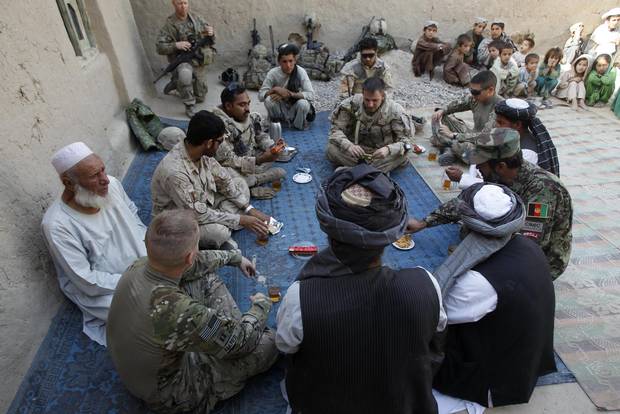
Canadian , US and Afghan army officers sit with local Afghan elders during a meeting in the village of Small Loi Kola in the Panjwai district, in the province of Kandahar June 23 , 2011. Canada will end its combat role in Afghanistan by the end of July, after nearly ten years fighting in the country.
Canadian, U.S. and Afghan army officers sit with local Afghan elders during a meeting in the village of Small Loi Kola in the Panjwai district on June 23 , 2011.
BAZ RATNER/REUTERS

Early in 2006, Amrullah Saleh, then the head of Afghanistan's National Directorate of Security (NDS), the country's principal intelligence service, decided to conduct a formal study of the Taliban's gathering resurgence, to inform Afghan President Hamid Karzai, his cabinet and allies of Afghanistan. He decided to interview active Taliban commanders personally. (There are few impermeable lines in Afghanistan's internal conflicts.) Mr. Saleh travelled to Zabul, Uruzgan, Helmand, Kandahar and other provincial capitals. His colleagues in regional NDS offices negotiated safe-passage agreements with Taliban commanders, who came in to talk to him. This sometimes involved paying the Taliban for their time and insights. Mr. Saleh's classified paper was completed in May, 2006, the same month Canada's Task Force Orion launched Operation Mountain Thrust, "to defeat the Taliban in their traditional areas." Commanded by Colonel Ian Hope, it was the first of a succession of operations intended to break the back of the Taliban's comeback around Kandahar, the movement's birthplace. Canadian forces fought hard, absorbed unexpected casualties and were often tactically successful, but trying to suppress the Taliban proved to be like "digging a hole in the ocean," as Canadian Major-General David Fraser, the top Canadian commander, put it.

Canada had run into a Pakistani covert operation to bring back the Taliban. In his paper, Mr. Saleh concluded that Pakistan's powerful Inter-Services Intelligence agency, or ISI, had made a decision in 2005 to support the Taliban more actively, with cash and other aid, backed by covert subsidies from Saudi Arabia. The consolidation of Mr. Karzai's government between 2003 and 2005 – a period when a new Afghan constitution was ratified and successful presidential and parliamentary elections were held – explained the timing of this Pakistani turn in policy, Mr. Saleh judged. He regarded Pakistan as an "India-centric country." In essence, he concluded, Pakistan's generals feared that Mr. Karzai's legitimacy would steer Afghanistan toward a durable role as an Indian ally, with international backing.
Soldiers of the U.S. 82nd airborne detain an Afghan man during Operation Alamo Sweep in southeastern Afghanistan on Nov. 7, 2002.
SCOTT NELSON/AP
His study predicted that the Taliban mobilization would intensify and that by 2009, the guerrillas would be advancing from rural strongholds to threaten major cities such as Kandahar. The paper forecast that the Taliban would mount a full-fledged insurgency that would bog down Afghan and international troops. This would turn out to be largely accurate, except that the Taliban drive on southern cities occurred even faster than that, at Canada's expense. The "Afghanistan government's legitimacy should not be brought down due to our inefficiency in knowing the enemy, knowing ourselves and applying resources efficiently," Mr. Saleh warned.

He passed his paper to the United States, and it seems likely that Canadian decision-makers and commanders saw it as well, but by then they were committed to the Kandahar campaign. They had to contend not only with the Taliban but with an Afghan President who discounted the seriousness of the insurgency. Mr. Karzairejected the study's findings. He ridiculed its predictions and asked Mr. Saleh to never again call the Taliban "an insurgency."

For years, Mr. Karzai clung to the conviction that the Taliban were a problem of international terrorism solely attributable to the ISI and that there was no indigenous cause of the revolt against his rule. He told U.S. General Stanley McChrystal in 2009, as the United States took charge of the war from NATO allies and dispatched tens of thousands of troops to escalate the fight: "An insurgency, as I understand the meaning, suggests there are citizens of a country who are fighting against their government because they think the government is illegitimate. Now, we are a conservative, simple Muslim people. If they are fighting against an illegitimate government, then who are you, the United States? You are propping up an illegitimate government. No. There is no insurgency."

Mr. Karzai believed, like many other Afghans, that the true story of the war – the essential problem – was not his government's corruption or legitimacy but the mysterious unwillingness of the United States to challenge the ISI and Pakistan. By the end of his time in power, Mr. Karzai had sunk into conspiracy thinking, concluding that the United States must want the ISI to succeed in destabilizing Afghanistan in order to justify maintaining U.S. military bases in his country.

American diplomats tried to dissuade Mr. Karzai of this belief, but until the end, he refused to yield. During a 2013 meeting, recalled James Dobbins, then the U.S. special envoy to Afghanistan and Pakistan, he said to Mr. Karzai: "Mr. President, between Edward Snowden and WikiLeaks, you have several million documents to examine – can you find any mention of such designs? Do you really think I would lie to you about this?"

"Maybe you don't know about the plan," Mr. Karzai replied, suggesting the existence of a "deep state" in America.

The truth was more prosaic. Distracted by the Iraq War and seeking to avoid deep entanglement in Afghanistan, the Bush administration was slow to recognize that it was being deceived by Pakistan's generals and spies. When it finally did wake up, toward the end of 2006, the Taliban had acquired momentum. The Bush administration and then the Obama administration conducted multiple reviews of strategy in Afghanistan but discovered few palatable options. If NATO launched an all-out war against the Taliban's sanctuaries in Pakistan, it would further destabilize a country containing dozens of nuclear weapons and at least that many terrorist groups. Instead, George Bush and then Barack Obama were sold on a counterinsurgency war against the Taliban inside Afghanistan, supplemented by a CIA-run drone war against Taliban encampments in Pakistan's western tribal areas.

Canadian forces held the line in Kandahar, of course, until the Americans poured in, in 2009. Some U.S. commanders were disdainful of Canada's "3-D" strategy of defence, diplomacy and development, which had suffered on contact with the Taliban early on, in 2006. Hubristically, the Pentagon believed that only American muscle could clear out Kandahar and other Taliban regions in the south and east. With greater numbers and a more unified command, the Americans did make some progress, at a high cost in lives and limbs, but gradually they also discovered that they were no better equipped than NATO allies to defeat the ISI's strategy – and that Maj.-Gen. Fraser's metaphor was apt.

Today, in the American-led war's 17 th year, U.S. and allied Afghan forces are still digging that hole in the ocean, hoping against all historical evidence that they can make enough progress on the battlefield to force the Taliban into a political settlement acceptable to most Afghans. The Trump administration has suspended aid to Pakistan in the hope that it will pressure the ISI to change course. The reaction in Pakistan since that announcement has been one of deep nationalist defiance.

Afghanistan has been at war for four decades. The only interlude of relative peace – apart from the years of smothering Taliban rule, which quieted many parts of the country – lasted from 2002 to 2006, years when many Afghans in exile came home to reclaim and rebuild their country. Counterfactual history is a fool's game, but if there ever was a chance to prevent Pakistan from interfering once again in Afghanistan through the ISI, and to incorporate significant numbers of former Taliban into constitutional politics, those were the years when it might have been done. And we can see now, in hindsight, that the framework of Canadian policy – security, reconstruction and active diplomacy to forge stable Afghan politics, backed by regional powers – was the right one. Instead, NATO failed to see what was coming out of Pakistan until it was too late and succumbed to hubristicAmerican strategy dominated by a Pentagon that repeatedly overestimated its capacity to change the course of the war. In its blindness, the alliance failed the many Afghans who relied on its power and promises.

Wednesday, June 22, 2016

Afghan service puts Defence Minister Sajjan in conflict of interest on detainees, say lawyers

By: David Pugliese, Defence Watch 

Defence Minister Harjit Sajjan’s work in the Canadian Forces, which included setting the stage for the killing or capture of some 1,500 Afghan insurgents, is enough to disqualify him from making the decision not to conduct a public inquiry into alleged abuses of detainees, say those pushing for such an investigation.

Sajjan, who could have been a potential witness for any Afghan inquiry, has dismissed outright the need for such an investigation even as new abuse allegations emerge.

Last week, Sajjan responded to an e-petition calling for the inquiry by stating the Canadian government ensured detainees were humanely treated, transferred or released in accordance with international law. That is a reversal of the Liberal’s demands, when in opposition, for a public inquiry.

But those advocating for the inquiry say Sajjan’s three tours in Afghanistan as a member of the Canadian Forces puts him in a conflict of interest.

“Does the fact that he was a senior officer in Kandahar at the time disqualify him from having oversight on this issue?” asked human rights lawyer Paul Champ. “Frankly, I think it does.

“He had relevant operational or on-the- scene information that could well be of interest to a commission of inquiry,” Champ added.

Retired Brig.-Gen. David Fraser has said Sajjan’s work as an intelligence officer and his activities in Afghanistan helped lay the foundation for a military operation that led to the death or capture of more than 1,500 insurgents. Sajjan was also later assigned to U.S. military forces.

The detainee issue has emerged on the Canadian political scene once again. Some Canadian military police officers say Afghan detainees were abused in their cells in Kandahar during surprise raids by Canadian guards in 2010 and 2011. A Defence Department document obtained by the Citizen acknowledges problems with the raids, noting the police who conducted the missions operated without oversight and lacked guidance.

In addition, military police officers have come forward to raise concerns that many Afghans taken prisoner by Canadian troops were innocent farmers and not members of the Taliban.

Such concerns were also highlighted back in 2007 when the head of Afghanistan’s intelligence agency also warned Canadian troops were grabbing innocent Afghans.

Canadian military officers have privately complained the detention of innocent Afghans may have helped push them to support the Taliban.

Sajjan, however, has said that in his three tours of Afghanistan he was never involved in any situations involving detainees.

“I wasn’t involved in this,” he explained last week. “I was using my experience as a police officer, engaging with the community, and one thing I can say is that the Canadian Armed Forces personnel, (with) the training that they have, abide by the Geneva Conventions and everybody who I served with, served with absolute credibility and honour.”

But some Canadian military police have disputed such statements.

Craig Scott, a law professor and former NDP MP who initiated the e-petition rejected by the minister, said Sajjan had dealings with Afghan officials, some of whom were later accused of torturing people. “(Sajjan) would be an absolute key witness” at an inquiry, Scott said.

Scott said because the treatment of detainees was never properly investigated by the Conservative government, the issue continues to be raised by some in the military concerned about incidents they saw in Afghanistan.

“It’s a festering sore that was never dealt with properly,” he added.

Tuesday, June 21, 2016

CAF Military Police Lacked Oversight in Afghan Abuse Claims

By; David Pugliese, The Ottawa Citizen 

CANADIAN MILITARY POLICE LACKED OVERSIGHT: DOCUMENTS

A human rights lawyer previously involved in the Afghan detainee case says newly released Defence Department documents obtained by the Citizen’s David Pugliese show the Canadian military is acknowledging something went seriously wrong in the Kandahar detention centre.

Canadian military police accused of terrorizing Afghan prisoners in their cells at Kandahar Airfield operated without oversight and lacked guidance, according to newly released Defence Department documents obtained by the Citizen.

The documents shed new light on allegations made last year by some military police officers who say Afghan detainees were abused in their cells in Kandahar during surprise raids by guards in 2010 and 2011.

Canaian soldiers lead Afghan detainees from a residential compound in southwest Kabul following a raid in 2004.
Canadian soldiers lead Afghan detainees from a residential compound in southwest Kabul following a raid in 2004. (CANADIAN ARMED FORCES FILE PHOTO)

The documents acknowledge the raids happened and suggest the situation was out of control.
Paul Champ, a human rights lawyer previously involved in the Afghan detainee issue, said the documents show the Canadian military is acknowledging something went seriously wrong in the Kandahar detention centre.

“I’m surprised the military didn’t take their investigation further and levy at least charges of misconduct,” said Champ, an Ottawa lawyer.

“Even if the actions didn’t meet some level of criminal threshold, although I would argue they do, it certainly would breach a code of conduct if these police officers weren’t properly trained or provided with oversight.”

Champ said there was no reason for military police to go into the cells on what they claimed was a training mission.

“It seems clear the purpose was to instil fear, to cause terror in these prisoners,” Champ said. “In my view that is a breach of humanitarian law.”

The issue of how Canadian military personnel treated Afghan detainees recently re-emerged on the political scene. Last week the Liberals rejected a request for a public inquiry even though they supported such an investigation while in opposition.

Canadian military police officers have also recently come forward to raise concerns that many Afghans taken prisoner by Canadian troops were innocent farmers or workers and not members of the Taliban or al-Qaida.

Last year, La Presse newspaper reported that Canadian military police conducted the surprise raids on detainees in their cells, roughing up prisoners in the process. The aim was to create a climate of high tension, which in turn could prompt detainees to provide information.

But the tactics terrorized the prisoners so much that some urinated or defecated during the raids, La Press reported. The Conservative government responded to the article by announcing that the Canadian Forces National Investigation Service had looked into the matter, but concluded no charges should be laid against their fellow police officers.

But behind the scenes, the La Presse article sent staff at National Defence headquarters in Ottawa scrambling, according to documents obtained by the Citizen under the Access to Information law.

Military police debated whether they should provide a copy of the 200-page investigation about the cell raids to the Conservative government. Information prepared for the Conservatives contained further details about how military police conducted themselves during such operations, which were supposed to provide training for officers.

“The investigation revealed that participants in the dynamic entry training lacked guidance and oversight required to carry out the work, and some had expressed frustration with the situation,” the Defence documents noted.

But military police later recommended that information be removed from the material sent to the Conservatives and in the Commons, James Bezan, parliamentary secretary of the Minister of Defence, instead recited the lines that the alleged actions were investigated and did not warrant any charges.

In November 2015, the Military Police Complaints Commission or MPCC launched an investigation into the incident. That decision was made after a complaint from an anonymous military police officer in which it was alleged that police conducted the exercises to terrorize detainees and in one instance entered the cells and manhandled prisoners. The officer also complained about the investigation into the incident and the fact that no charges were laid or court martial convened.

The MPCC interviewed a number of individuals aware of the raids and confirmed that several detainees were so scared they defecated and urinated on the spot during one such foray into the cells.

A day after launching its investigation, the complaints commission requested the documents relating to the police probe. But the Canadian Forces delayed release of that material for seven months.

It was finally received on June 10, MPCC spokesman Michael Tansey confirmed Monday.

“The MPCC has just received the documents and other material received and is reviewing them to determine if additional materials are required,” he said.

Thursday, June 16, 2016

NDP renews call for inquiry into Afghan detainee abuse

By: Amanda ConnollyiPolitics 

The NDP repeated calls Wednesday for a full public inquiry into the Afghan detainee abuse scandal amid fresh allegations by former military police officers who served in Afghanistan in a letter to La Presse.

Canadian soldiers with the NATO-led International Security Assistance Force (ISAF) walk during a patrol in Panjwayi district 30 km in the west of Kandahar province on March 28, 2008.
“We’ve called for a public inquiry for a number of years and the Liberals supported that call when they were in opposition,” said NDP defence critic Randall Garrison. “When we asked the minister of defence on Monday, there was no response so we’re repeating the call today for a full public inquiry.”

La Presse posted the letter online Wednesday morning (it can be read here) alleging that almost half of the Afghans captured and detained by Canadian soldiers had nothing to do with the Taliban.

It also says that most of them were released for lack of evidence after spending an average of two months in detention.

The former Conservative government had said the prisoners were held by Canadians for between 48 and 96 hours.

“What we have here is a potential stain on Canada’s international reputation through possible violations of international law, and also a stain on the reputations of all those Canadians who went there and served,” Garrison said.

Garrison, along with NDP foreign affairs critic Helene Laverdiere, called for an inquiry focused on whether there was a clear policy created to deal with the transfer of detainees after the lack of one was identified as a problem, and how the Afghans held in Canadian custody were treated.

Conservative defence critic James Bezan said Wednesday he doesn’t think there is evidence to suggest the need for an inquiry, calling the letter in La Presse “one person’s opinion.”

“It all comes back that our troops have conducted themselves honourably,” said Bezan. “I don’t believe that the evidence is there. As you know, there was a special parliamentary committee that went through all the documentation and again came up that there was no reason to pursue any further inquiry.”

The Liberals and NDP both called for an inquiry while in opposition during the Conservatives’ minority mandate in 2009.

The government formed an all-party committee to go through documents on the issue but refused to release unredacted records to the committee.

The government was ultimately voted in contempt of Parliament by the opposition parties for their refusal and Prime Minister Stephen Harper prorogued Parliament before disbanding the committee after their 2011 majority win.

Friday, June 3, 2016

CDA Institute Analysis – “Trudeau’s Promises: From Coalition Operations to Peacekeeping and Beyond”


In this new CDA Institute Analysis, Stéfanie von Hlatky looks at the key considerations that should help guide the deployment of the Canadian Armed Forces (CAF). The following is an excerpt of the Analysis.

Academic and policy discussions on Canada’s future role in multinational military interventions inevitably refer back to the long war in Afghanistan. Canada’s involvement, as part of Operation Enduring Freedom (OEF) and the International Security Assistance Force (ISAF) evolved significantly over the years. Canada’s reputation as an alliance partner also improved noticeably in the process. As of 2006, the Canadian Armed Forces (CAF) were known for operating with few caveats and were at the forefront of developing a viable whole-​of-​government approach as part of their design of the Provincial Reconstruction Team (PRT) in Kandahar, despite obvious shortcomings.

Although the success metrics of the war in Afghanistan are hard to establish and the overall outcome of the intervention is inconclusive at best, the experience tells us a lot about Canada’s standing in alliance politics and what the CAF can be expected to do in the future as part of those coalitions, given the skills and expertise acquired during this war-​intensive period. Indeed, the CAF acquired diverse skills as the intervention called for both community engagement and warfighting, with a lot of necessary adaptations along the way.

Beyond the lessons learned from the previous war, Canada’s military role abroad should be guided by clear foreign and defence policy guidelines. The last defence policy statement dates back to 2008. With the economic recession hitting the country at about the same time, many of the plans outlined in the Canada First Defence Strategy had to be shelved. Now that there is a Liberal government in power, under the leadership of Prime Minister Justin Trudeau, the Department of National Defence (DND) has been tasked with conducting a defence review. The review process includes public consultations across Canada, through the organization of events, roundtables, and discussions on social media. The result of this process will be unveiled in January 2017 and will provide greater clarity on Canada’s role in operations, force levels, readiness, and personnel issues.

This paper examines the conditions under which Canada should consider deploying the CAF and considers some of the motives that play into the decision-​making process. It does so by taking into account past and current CAF operations, as well as the defence priorities that have already been announced by the government. I argue that, moving forward, the Canadian government ought to think much more about the type of mission that is well suited for the CAF, where Canadian soldiers are most needed, as well as which allies and partners are best to work with.

Alliance Politics

One of the assumptions of this paper is that maintaining a reputation for reliability within an alliance setting is one of the main currencies of influence for a medium-​sized country like Canada. Therefore, decisions on the use of force are assessed in reference to Canada’s most important allies. That being said, it is worth asking whether Canada paid too high of a price to boost its reputation over the course of the Afghan War. In Afghanistan, but also more recently in Iraq as a member of the global coalition against the Islamic State, Canada strived to make military contributions that place it in the top tier of participating countries. As mentioned before, Canada is also seen as an alliance partner capable of deploying its armed forces with few restrictions on what they can do on the battlefield, meaning a higher tolerance for risky missions, which plays into allies’ qualitative assessments of burden-​sharing. The nightmare of coordinating national caveats was felt by ISAF commanders as they had to consider the various contributions made by each ally and partner, factoring in each nation’s rules of engagement and restrictions on their mobility in order to translate pledges into effective multinational military cooperation.

Given what Canada has invested in previous military interventions, the government would do well to invest in mechanisms that preserve allies’ coordination capacity and interoperability, either as part of NATO or US-​led coalitions. For NATO, the Secretary-​General has insisted on the utility of the Connected Forces Initiative (CFI) as the means through which NATO allies and partners can retain their capacity to work closely together, as refined through ISAF and Operation Unified Protector in Libya. The message was reinforced during the 2014 Wales Summit:

We continue to build on the experience gained in recent operations and improve our interoperability through the Connected Forces Initiative (CFI). Today we have endorsed a substantial CFI Package consisting of six key deliverables, including the high-​visibility exercise Trident Juncture 2015, with 25,000 personnel to be hosted by Spain, Portugal, and Italy; a broader and more demanding exercise programme from 2016 onwards; and a deployable Special Operations Component Command headquarters.

Through CFI or military exercises led by the Alliance or individual nations, Canada has a stake in continuously sharpening its capacity to operate with other Western armed forces.

Why Participate in Military Operations?


The government of Canada, currently engaging in a comprehensive defence policy review, will examine how alliance ties can enhance the country’s foreign and defence policy goals, but the scope of the exercise is much broader. The review, which was launched by Defence Minister Harjit Sajjan in April 2016, is articulated around three issues: identifying the most pressing security challenges, defining the role of the CAF in meeting those challenges and finally, establishing the appropriate mix of capabilities needed by the CAF to accomplish their missions and tasks successfully. Therefore, as a point of departure, it is worth asking which security challenges or motives guide decisions on the use of force.

The primary motive for investing in the armed forces is national defence and, by extension, to contribute to regional and global security for the sake of international stability. In Canada, the absence of an existential security threat means the country’s military commitments are primarily assessed through alliance politics, especially the bilateral relationship with the United States. The US has a more expansive perception of threat than Canada, given its massive and global military footprint. Based on numerous treaty commitments and alliance ties, American armed forces have been deployed all over the world to defend US interests and partners, with the goal of ensuring international stability through the projection of its power. In Canada, decisions on the use of force are often taken as the result of US or NATO initiatives. Finally, the Canadian government may choose to use force for humanitarian purposes. The humanitarian logic of intervention can lead to operations ranging from disaster relief or peace support operations.

Click here to read the rest of the CDA Institute Analysis.

Dr. Stéfanie von Hlatky is an assistant professor of political studies at Queen’s University and the Director of the Queen’s Centre for International and Defence Policy (CIDP). (Image courtesy of David Goldman/​Associated Press.)

Thursday, January 21, 2016

RCAF & the CH-146 Griffon: Upgrade and Replace

BY KEN POLE
 2015 FrontLine Defence © (Vol 12, No 6)

Back in 1992, the Canadian Armed Forces (CAF) bought the Bell CH-146 Griffon helicopter, a version of the Bell 412EP, as a replacement for three earlier Bell platforms – CH-136 Kiowa light observation, CH-118 Iroquois search and rescue (SAR) and CH-135 Twin Huey tactical and utility – as well as, for some operations, early models of the Boeing CH-147 Chinook tandem-rotor heavy lifter.


However, even before the sole-source procurement contract to Bell Helicopter Textron Canada(BHTC) was ­confirmed, there was criticism that it was politically motivated. Moreover, the one-size-fits-all approach meant that the Griffon, fundamentally designed as a light utility helicopter, was compromised from the get-go. Among other things, it was disparaged as “a civilian […] aircraft with a coat of green paint.”

But the government forged ahead, ordering 100. They were delivered between 1995 and 1997 in two configurations: the Combat Support Squadron (CSS) version for SAR work, and the Utility Tactical Transport Helicopter (UTTH). While it can be fitted with 13 seats for a crew of three with 10 passengers, weight ­constraints generally resulted in a combat load of eight troopers or even fewer, depending on the fuel and armaments.

The concern arises when you compare the anticipated delivery timelines specified in the Defence Acquisition Guide. Could the expense be better managed?

The CAF still has 85 Griffons in service and their crews have acquitted themselves well in the couple of decades they have been in service at home (SAR, surveillance and reconnaissance, casualty evacuation, drug interdiction and security) and abroad. They have been central to international humanitarian relief operations in many countries because they easily transportable, rotor blades removed, by the RCAF’s Lockheed Martin CC-130J Hercules or Boeing CC-177 Globemaster IIIs.

The highest-profile overseas deployment, other than on relief missions, was Canada’s participation in the 2001-2014 NATO-led International Security Assistance Force (ISAF) in Afghanistan. The first six arrived aboard a Globemaster at Kandahar Air Field just before Christmas 2008.
SAREX 14 participants work as a team to carry a mock casualty from a CH-146 Griffon helicopter at Wing Goose Bay, Newfoundland and Labrador. (Photo: Cpl Manuela Berger, 4 Wing Imaging)
Griffon crews from tactical helicopter squadron were tested in a broad spectrum of roles duringOperation Athena, including flying in pairs as gunship escorts to Chinook troop transports, providing top cover for ground convoys, and inspecting roadways for improvised explosive devices.

They mostly were flown at altitudes below the surrounding mountains – they simply could not be flown “hot and high” if they were to carry useful loads. Even though the Griffon has a service ceiling of about 6,000 metres, that’s achievable only under ideal conditions. At higher altitudes, the pitch angle of the rotor blades has to be increased, resulting in increased drag which more than offsets any increase in lifting capacity. Its hover ceiling is only 3,109m, again under ideal conditions.

General Rick Hillier, the Chief of the Defence Staff from February 2005 to July 2008, was among those who criticized their deployment to Afghanistan because of the power-deficiency issue. However, Peter MacKay, who held the defence portfolio from 2007 to 2013, defended the Griffon as “a superior helicopter . . . that serves our interests both in Afghanistan and for purposes here in Canada.”

While arguably suited to domestic operations, its shortcomings in Afghanistan were cited at a United Kingdom coroner’s inquest into the death of a British army officer, along with two Canadian troopers, Corporals Pat Audet and Martin Joannette, in a Griffon crash in July 2009. It happened at Forward Operating Base (FOB) Mescall, 1,550 metres above sea level in southern Zabul province. A dense dustball whipped up by the rotor blades on takeoff meant that the command pilot had to rely on instruments. The helicopter drifted sideways, struck the FOB perimeter wall and caught fire after falling about two metres to the ground. Both pilots and a fifth Canadian survived.

A senior officer from the UK Defence Helicopter Flying School at Royal Air Force Base Shawbury testified at the inquest that operating a loaded Griffon at that altitude and in high ambient temperatures meant that it was inappropriate for the mission. The coroner eventually concluded that the command pilot had “suffered a loss of situational awareness during the takeoff due to the rapid and numerous changes in his focus during the 10 seconds prior to impact as he attempted to stabilize the aircraft and climb away.”

In a heavily-redacted report, a CAF Board of Inquiry concluded that the condition of the landing zone and the pilot’s technique were “direct” factors in the crash and that incorrect application of aircraft performance charts and exceeded engine temperature were “indirect” factors. Even though the report also faulted pre-deployment training, the Board concluded that the mission had been “appropriately tasked and authorized”.

During and after the Afghanistan deployment, various Canadian military websites have been flooded with often negative observations about the Griffons’ suitability for the ISAF mission and, by extension, any theatre of operations where with hot and/or high conditions are unavoidable.

In January 2011, a $640-million repair and overhaul contract went to BHTC of Mirabel, Quebec, where they were built, with some work going to Bell’s Calgary facility as well as other companies in the supply chain.
Aug 2014 – Griffon pilot talks with members of 1 Canadian Ranger Patrol Group, as members of the Royal Canadian Navy disembark on Baffin Island, Nunavut, during Operation NANOOK. (Photo: MCpl Johanie Maheu, 14 AMS Wing Imaging)
Officially known as the CH-146 Optimized Weapon System Support (OWSS) contract, it combined three previous contracts for Bell to provide engineering support, repair and overhaul, and supply support. The 10-year contract was intended to keep the helicopters flying through to potential retirement in 2021 and possibly push that out to 2025. It included some management services, engineering and technical publications, aircraft maintenance services and spare and consumable parts.

Some 16 months after the Bell award, L-3 WESCAM of Burlington, Ontario, secured a 3-year contract for up to $10 million, with two optional 1-year extensions, for routine maintenance, repair and overhaul of the fleet’s electro-optical and infrared (EO/IR) imaging sensors which enable the Griffon to operate as an escort or support Army operations day or night surveillance, a key factor during Operation Athena in Afghanistan.

At the time, then Prime Minister Stephen Harper described the contract as not only “great news” for BHTC but also would help to “strengthen the aerospace industry” in Quebec and Alberta.

But back to the question of directing scarce resources towards propping up old platforms for a two-year gap rather than speeding up procurement of newer alternatives that are better suited to extreme flying conditions. The current plan will see more funding for 20-year-old helicopters that can’t keep up with the RCAF’s 16 new F-model Chinooks (which cruise at 130 knots to the Griffons’ 118, and an even wider top-speed differential of 170 knots to 139!). Why slow down a transport, when it’s essential to get troops on the ground quickly, so that the escorts can keep up?

A simple answer is that Canada’s Air Force has a long history of being forced to fly assets longer than originally intended but one has to wonder if the new Liberal government will be looking at more efficient ways of getting the job done.

The Griffons are undeniably due to be retired; they will be obsolete and unable to operate out of the country by 2021. By then, NATO interoperability issues and compliance with aviation authorities’ requirements for higher fidelity navigation in the avionics will surely be a problem.

At a cost of $500 million to $1.5 billion, DND is planning that the Griffon Limited Life Extension In-Service Support (GLLE), will, among other things “replace obsolete cockpit instrumentation and radios with components that are supportable to 2030 and possibly beyond.” The final delivery, according to the 2015 Defence Acquisition Guide, is expected to be 2024 (three years after obsolescence and facing ever-increasing operations and maintenance costs due to the age of the platform).
Special Operations personnel prepare to fast-rope onto a CFB Petawawa practice tower. 427 squadron provides ­tactical airlift of troops and equipment, casualty evacuation and logistical support, and supports SAR operations in central Canada as required. (Photo: Ken Pole)
On the other hand, the Tactical Reconnaissance Utility Helicopter (TRUH) program, which is intended to replace the aging Griffons with more capacity and capabilities, at a cost of more than $1.5 billion, has the Definition Approval date set for 2021, and specifies the first delivery in 2026.

Fleet commonality is important to reduce costs, however, there will be a 5-10 year transition period where both aircraft are in service. But there are ways to benefit. One option would be to start the TRUH program earlier, even immediately, while undertaking GLLE for part of the Griffon fleet. In this way, DND can maintain operational capability with the Griffon while moving to a more capable platform. The money saved with a partial GLLE could be applied towards the new platform.

That new helicopters would cost more than $1 billion, is undeniable. But, as a former federal finance minister put it, “short-term pain for long-term gain” is an economically sound model.

====
Ken Pole is a contributing editor at FrontLine.
© FrontLine Defence 2015