By: David Pugliese, Defence Watch
Companies have until April 18 to provide information to the Canadian government for a unmanned aerial system (UAS) for the Royal Canadian Navy. The UAS would be used onboard a Halifax-class warship, according to Public Services and Procurement Canada. The RCN is looking for a proven system “that is technically airworthy, and has an already established supply chain and maintenance schedule,” according to information provided to industry.
“The UAS will enhance the Halifax-class frigate’s ability to conduct sustained, extended, concealed Over The Horizon (OTH) surveillance, targeting, and intelligence gathering operations required to locate, identify and interdict Contacts of Interest (COI) or similar effects in support of forces in open ocean or the littorals,” the department noted.
“Noting that an embarked Maritime Helicopter on a typical six month deployment would fly approximately 500 hours, while operating a 12 hour deck cycle; it would not be unreasonable to consider that the UAS could fly closer to 1000 hours in that same period. This would provide the host warship with a UAS that could fly up to 12 hours every other day (or iterations thereof).”
Public Services and Procurement Canada noted the UAS should not require any launch and recovery apparatus.
Here are more details (provided by the department) on the aircraft the RCN would be interested in:
-The UAS must have a minimum of six (6) hour endurance in order to meet a minimum of 3.5 hour on station time, a minimum of 50 NM from the host ship while fitted with a core payload, while operating at 50kts.
– The UAS must operate in challenging maritime conditions, which include up to sea state 4, headwinds of 25 knots with crosswinds of 10 knots and gusts up to 40 knots, temperatures ranging from -30 to +40 Celsius and rainfall of up to 4mm per hour.
-The UAS must remotely operate Beyond Visual Line of Sight (BVLOS), extending a ships current sensor range beyond 50nm, in order to effectively perform ISTAR related tasks at a tactically relevant range.
-The UAS must have a core set of payloads installed at all times to include EO/IR, maritime radar, AIS, and an IFF Transponder, and the UAS must be able to add additional mission specific payloads to support the ISTAR mission of the day.
The government’s request for information is aimed at refining the RCN’s requirements.
Showing posts with label UAS. Show all posts
Showing posts with label UAS. Show all posts
Thursday, March 30, 2017

Friday, February 24, 2017
Drones Expected to Operate from RCN Vessels Within Decade
By: Brett Ruskin, CBC News
Canada's fleet of frigates will have new airborne assets in the next decade, according to a report listing the advantages of unmanned airborne drones.
An unmanned aircraft system, or UAS, could be deployed from the deck of a ship to identify targets, do reconnaissance and gather intelligence in areas where human-piloted helicopters could not.
In hostile environments, drones offer an "inherent operational advantage," the Royal Canadian Navy said in documents published online this month.
Double the flight hours of a helicopter
The details of the plans were found in a government request for information from industries, commonly sought prior to issuing tenders for goods or services.
"An embarked Maritime Helicopter on a typical six month deployment would fly approximately 500 hours," the document said.
"The UAS could fly closer to 1,000 hours in that same period."
The document does not say which drone model will be purchased, but it does list its requirements:
"The embarked UAS must ensure that its launch and recovery has minimal interference with the deck cycle of the embarked Maritime Helicopter," the document says.
While the drones may see more flight time, helicopters with on-board pilots will remain the ship's aerial workhorses.
The drones will not be weaponized, carry personnel or heavy payloads and will have a much shorter range than the helicopters.
Other navies have already deployed drones
Earlier this month, the Royal Australian Navy announced it would purchase a number of Camcopter S-100 unmanned vehicles from Austria's Schiebel Group.
The drone helicopter can carry 34 kilograms — typically cameras and sensors — for more than six hours and has a range exceeding 200 kilometres, according to the manufacturer.
The same model has also been purchased by navies in Italy, Jordan, Libya, Russia and China.
The United States defense department is working with American company Northrop Grumman to develop another type of ship-based unmanned aircraft.
The Canadian military will continue gathering input from industry officials this year.
A request for proposals is scheduled to be issued in 2020 and a contract to supply the UAS awarded sometime in 2021.
Canada's fleet of frigates will have new airborne assets in the next decade, according to a report listing the advantages of unmanned airborne drones.
An unmanned aircraft system, or UAS, could be deployed from the deck of a ship to identify targets, do reconnaissance and gather intelligence in areas where human-piloted helicopters could not.
In hostile environments, drones offer an "inherent operational advantage," the Royal Canadian Navy said in documents published online this month.
Double the flight hours of a helicopter
The details of the plans were found in a government request for information from industries, commonly sought prior to issuing tenders for goods or services.
"An embarked Maritime Helicopter on a typical six month deployment would fly approximately 500 hours," the document said.
"The UAS could fly closer to 1,000 hours in that same period."
 |
| The new unmanned aircraft will be stored alongside the Maritime Helicopter that is deployed with each Canadian frigate. Here, a diagram included in the request for information is superimposed on an aerial image of HMCS Charlottetown. (Cpl. Blaine Sewell / DND) |
- Minimum flight time of six hours.
- Minimum range of 50 nautical miles from the ship (92.6 km).
- Ability to handle crosswind gusts up to 40 knots (74 km/h).
- Not require any launch or recovery apparatus.
- Vertical take-off and landing or rotary wing capability.
- Won't hamper helicopter operations
"The embarked UAS must ensure that its launch and recovery has minimal interference with the deck cycle of the embarked Maritime Helicopter," the document says.
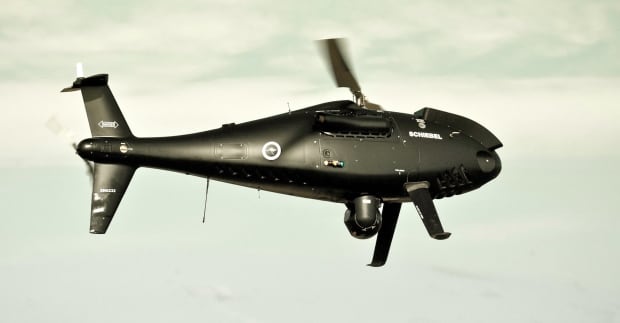 |
| The Schiebel S-100 unmanned aerial vehicle (Schiebel Group) |
The drones will not be weaponized, carry personnel or heavy payloads and will have a much shorter range than the helicopters.
Other navies have already deployed drones
Earlier this month, the Royal Australian Navy announced it would purchase a number of Camcopter S-100 unmanned vehicles from Austria's Schiebel Group.
 |
| Add captionThe Northrop Grumman TERN is designed to take-off vertically like a helicopter, then rotate in midair to fly like a fixed-wing plane. (Northrop Grumman) |
The same model has also been purchased by navies in Italy, Jordan, Libya, Russia and China.
The United States defense department is working with American company Northrop Grumman to develop another type of ship-based unmanned aircraft.
The Canadian military will continue gathering input from industry officials this year.
A request for proposals is scheduled to be issued in 2020 and a contract to supply the UAS awarded sometime in 2021.
Subscribe to:
Posts (Atom)