Translate

Showing posts with label Drones. Show all posts

Friday, February 24, 2017

Drones Expected to Operate from RCN Vessels Within Decade

By: Brett Ruskin, CBC News 

Canada's fleet of frigates will have new airborne assets in the next decade, according to a report listing the advantages of unmanned airborne drones.

An unmanned aircraft system, or UAS, could be deployed from the deck of a ship to identify targets, do reconnaissance and gather intelligence in areas where human-piloted helicopters could not.

In hostile environments, drones offer an "inherent operational advantage," the Royal Canadian Navy said in documents published online this month.
Double the flight hours of a helicopter

The details of the plans were found in a government request for information from industries, commonly sought prior to issuing tenders for goods or services.

"An embarked Maritime Helicopter on a typical six month deployment would fly approximately 500 hours," the document said.

"The UAS could fly closer to 1,000 hours in that same period."
The new unmanned aircraft will be stored alongside the Maritime Helicopter that is deployed with each Canadian frigate. Here, a diagram included in the request for information is superimposed on an aerial image of HMCS Charlottetown. (Cpl. Blaine Sewell / DND)
The document does not say which drone model will be purchased, but it does list its requirements:
  • Minimum flight time of six hours.
  • Minimum range of 50 nautical miles from the ship (92.6 km).
  • Ability to handle crosswind gusts up to 40 knots (74 km/h).
  • Not require any launch or recovery apparatus.
  • Vertical take-off and landing or rotary wing capability.
  • Won't hamper helicopter operations
The military is clear that the UAS should complement existing helicopter operations, not impede them.

"The embarked UAS must ensure that its launch and recovery has minimal interference with the deck cycle of the embarked Maritime Helicopter," the document says. 
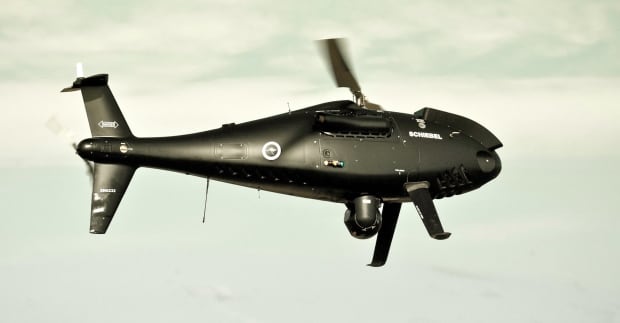
The Schiebel S-100 unmanned aerial vehicle (Schiebel Group)
While the drones may see more flight time, helicopters with on-board pilots will remain the ship's aerial workhorses.

The drones will not be weaponized, carry personnel or heavy payloads and will have a much shorter range than the helicopters.
Other navies have already deployed drones

Earlier this month, the Royal Australian Navy announced it would purchase a number of Camcopter S-100 unmanned vehicles from Austria's Schiebel Group.
Add captionThe Northrop Grumman TERN is designed to take-off vertically like a helicopter, then rotate in midair to fly like a fixed-wing plane. (Northrop Grumman)
The drone helicopter can carry 34 kilograms — typically cameras and sensors — for more than six hours and has a range exceeding 200 kilometres, according to the manufacturer.

The same model has also been purchased by navies in Italy, Jordan, Libya, Russia and China.

The United States defense department is working with American company Northrop Grumman to develop another type of ship-based unmanned aircraft.

The Canadian military will continue gathering input from industry officials this year.

A request for proposals is scheduled to be issued in 2020 and a contract to supply the UAS awarded sometime in 2021.

Tuesday, March 1, 2016

Trudeau Government Shopping for Drones; RCAF Wants them Armed

Written by: Murray Brewster, The Associated Press, published by The National Post 

OTTAWA — The Trudeau government is quietly shopping for drones for the military and expects to see expressions of interest from the defence industry by mid-April.

But the tire-kicking exercise is setting the stage for a potentially bruising policy debate over whether the remotely controlled aircraft should be armed and under what circumstances they would employ deadly force.

The Royal Canadian Air Force has lobbied hard over the last few years for the capability to fire weapons from whatever drone is selected and has even written the assumption into mandatory requirements, according to a series of access to information records obtained by The Canadian Press.

Under the heading “Lethality,” the high-level requirements review — dated June 5, 2013 — explicitly states that whatever system is chosen, the RCAF expects the remotely piloted aircraft to be capable of “carrying and employing precision-guided munitions.”

A separate slide presentation, dated Dec. 12, 2013 and intended as an update for the project management office at National Defence, noted there would have to be support for a precision-strike capability, but anticipates “public concern.”

The Pentagon and CIA run drone programs which have been subject to increasing scrutiny and criticism, particularly in light of the dramatic rise in strikes over the last eight years and claims of civilian casualties.

The intelligence agency’s program of targeted assassination has been the most controversial, prompting the Obama Administration to pledge three years ago to create “clear guidelines, oversight and accountability” when it comes to decisions to employ lethal force.

A Washington-based think tank of former generals and policy experts has been monitoring the promise and issued a report card this week that gave the administration a failing grade, particularly around transparency.

A spokesman for National Defence, Evan Koronewski, acknowledged the air force wants a strike capability, but the drones Canada intends to buy will “be used primarily for surveillance and reconnaissance” of the coastlines and the Arctic.

“The policy and operational questions posed by the use of these systems are significant and require careful thought and discussion within Canada and internationally,” Koronewski said in an email.

“However, it is clear that the legal implications of the use of these systems vary depending on the context and legal framework. Any such system acquired by Canada would be compliant with Canada’s domestic and international legal obligations and employed in a manner that is consistent with these obligations.”

But Errol Mendes, a University of Ottawa professor and an expert in international law, says there will have to be more than careful thought and discussion.

He says the Trudeau government should start now to develop a framework of transparency and accountability for the use of those weapons system, if only to avoid the kind of public debate and condemnation that’s happened in the U.S.

“The issue is quite pertinent given the huge range of debate that’s gone all of the way up to the president,” said Mendes, who recently lectured the NATO council on the subject.

Introducing a Canadian program “must be done with utmost care and supervision” and with highly trained operators, he said.

“That whole area needs to be studied very, very carefully. I am not actually against well-trained and well-focused use of weaponized drones, which meet the parameters of international humanitarian law. So, I’m not against it. I know others are, but I am not.”

What needs to happen, Mendes said, is that every time the weapons are fired, it is cleared at the top, by either the defence minister or the prime minister. He says there needs to be a clear chain of responsibility that stretches beyond the military to the political level.

Retired colonel George Petrolekas, of the Conference of Defence Association Institute, says he knows there’s been debate, but hasn’t seen any evidence of the policy architecture that would be needed to run a drone program.

He also suspects that the ballooning federal deficit will put a crimp in plans to acquire drones around 2020.

Thursday, February 26, 2015

RCAF Drone's To Be Purchased or Further Delay?

The RCAF has been looking to purchase Drones (UAVs) since it outlined its various options to Air Force Staff in 2005.

The issue is, the following year in 2006, Canada's operations in Afghanistan picked up, and Canada opted to lease UAVs for immediate use from numerous aerospace industries, with the option to purchase them at a later date. The full financials were not provided to the RCAF for these options according to an internal audit.

The RCAFs Joint Unmanned Surveillance Targeting and Acquisition System (JUSTAS) was supposed to be operational in 2010. That date was later pushed back to 2012, and just recently been pushed to 2017.

However, recent reports from the RCAF to industry experts, the Air Force does not expect UAV operational systems in place until 2023.

The latest outline shows a contract awarded for the drones possible between 2019 and 2020, with delivery taking place between 2021 and 2025. That is if the RCAF procurement stays with its plan this time, it will only be a decade and a half behind schedule. Who knows what operations we will be involved in in 2025, and what capability we will require.