Translate

Showing posts with label Training Police. Show all posts

Monday, June 12, 2017

Canada Considering NATO Request for Police Trainers in Afghanistan

By: Laura Payton, CTVNews Online 

OTTAWA -- Canada is considering a NATO request to send police trainers to Afghanistan, three years after the military mission officially ended, Defence Minister Harjit Sajjan says.

The request came from the U.S. through NATO, and could involve either civilian police trainers like the RCMP, or military trainers working with Afghan police, a defence official added.

Sajjan says Canada is "looking at all aspects of support" for Afghanistan -- though he ruled out the country as a destination for Canadian peacekeepers since it's not a UN mission.
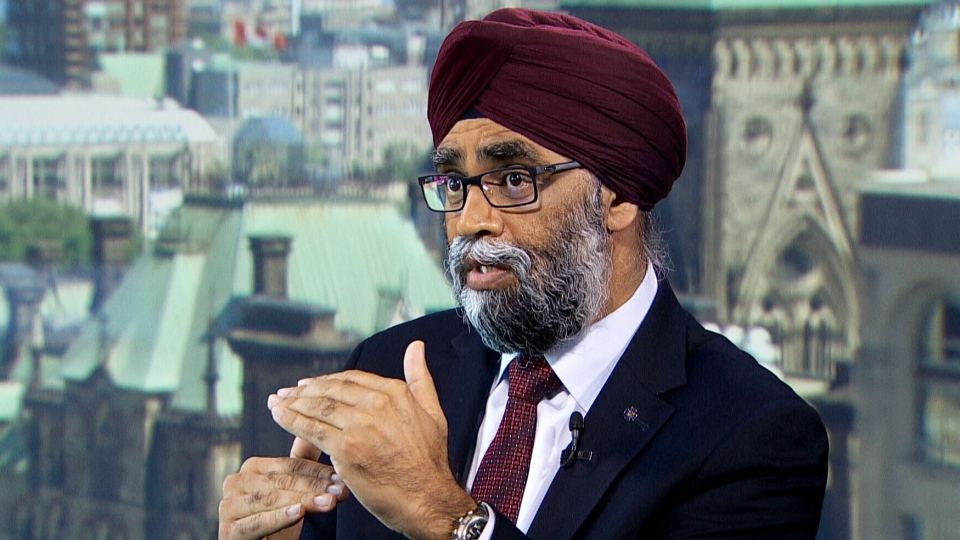
Defence Minister Harjit Sajjan speaks on CTV's Question Period. (CTV)
"We've actually had an ask, but it was for police trainers in Afghanistan," Sajjan said in an interview with Evan Solomon, host of CTV's Question Period.

"We are actually still committed to Afghanistan. We've provided the funding, whether it's for development" or salaries for security forces in the country, he said.

From 2014 to 2017, Canada committed $227 million in international development programs in Afghanistan, and $330 million from 2015 to 2018 in support for the Afghan National Security Forces, which include the Afghan National Army and the Afghan National Police.

Sajjan says Canada can't look at any country in isolation.

"This is what coalitions are for, multilateralism is for. I'm in constant discussions with my counterparts on all the various threats, whether it's at NATO or the counter-DAESH meetings," he said, using another name for the Islamic State.

"We will always look at the various requests, but the thing is when we have the discussions, it's not about just one nation ... stepping up and saying, 'I'll do this.' It's about working together."

Peacekeeping mission 'on the table'

Last August, Sajjan announced Canada would devote 600 troops and $450 million over three years to a peacekeeping mission. He later toured several African countries and said he would announce the mission by the end of the year, but six months into 2017 there is still no word on where it will be.

A mission somewhere in the world "is on the table. We're committed to peace support operations," Sajjan said, citing a change in leadership at the UN and the new president of the U.S. as reasons for the delay.

"I've had discussions with [the UN], things looked very good... It's not about just sending troops. How can we now look at the current environment and bring our unique skillset to the table?"

While Sajjan ruled out Afghanistan as a peacekeeping destination, Richard Fadden, a former top civil servant at the Department of National Defence and former national security adviser to the prime minister, says having shed blood and spent a great deal of money on the country, it would make sense to return.

"Afghanistan has deteriorated quite a bit over the last few years," he said.

"I think if we were going anywhere to make a contribution, broadly speaking, to peace in the world, Afghanistan would be a good place to go. There are not that many other places where we could make a difference that would not result in ... our being involved in a massive quagmire."

Retired Gen. Tom Lawson, a former chief of the defence staff, says he prefers Afghanistan to some of the African countries Canada could end up, like Mali or the Democratic Republic of Congo. Both would carry significant risks for Canadian Armed Forces personnel.

"If it keeps us out of other places, [like] in Africa, I'd be delighted as a former chief of defence," Lawson told Solomon.

"So Afghanistan is a place that Canadians have invested both money and blood. We continue to invest money there. If a return was in Canadian defence future, it would be to a familiar zone."

Over the 12-year mission, 158 Canadian troops were killed, as well as a diplomat, a journalist and two civilian contractors, according to a tally by The Canadian Press.

Wednesday, December 2, 2015

Canada in Iraq: CAF Could be Joined by Police for Larger Training Mission

Written by: Murray Brewster, The Canadian Press

BRUSSELS -- The scope of the Trudeau government's reconfigured mission in Iraq will be broader than just the military and could include a sizable police training contingent, Canada's foreign affairs minister said Wednesday.

Stephane Dion found himself repeatedly buttonholed in the polished hallways of NATO headquarters over the last two days, sometimes by countries eager for Canada to join their endeavours, as the United States made clear it expects allies to do more in the fight against the Islamic State of Iraq and the Levant.

"It's more than just military, but it's always about security," Dion told The Canadian Press in an interview.

"You can't have security only with military. You have security when people feel secure with their institutions and they believe in them."

One of his nine bilateral meetings included the Italian foreign minister and the possibility of Canada joining Italy in Iraq's Kurdish north. More than 100 Carabinieri -- Italy's national police force -- are training local police in areas recaptured from ISIL.

"Is it an area where we may have a contribution that would be welcome? It is something we have to discuss with the Americans, with the Italians and others," said Dion.

He added that Defence Minister Harjit Sajjan is leading the drive to recraft the mission following the withdrawal of CF-18 jetfighters from combat, which is expected to happen sometime this winter.

During the election campaign, Prime Minister Justin Trudeau promised a beefed-up mission to train local forces in Iraq, over and above the existing 69 special forces instructors working the Kurdish peshmerga in the north of the country. The government has yet to provide details on what the mission would look like.

The pressure is not only on Canada, but all NATO allies. Earlier Wednesday, U.S. Secretary of State John Kerry delivered a tough, unambiguous message, saying the United States expects them to do more in the war against ISIL.

He told his 27 other counterparts that the international coalition "must strike at the core" of ISIL and strangle its efforts to set up networks elsewhere.

"I called on every NATO ally to step up its fight against Daesh," Kerry said, using the Arabic acronym for the militant group, also known as ISIL and ISIS.

"I was very gratified that a number of allies are already bringing more to this battle -- or are planning to increase their contributions."

He praised British Prime Minister David Cameron, whose Parliament is poised to vote on expanding airstrikes into Syria and Germany, which plans to deploy ships and surveillance aircraft to support operations against ISIL.

"It's a very important step, we applaud his leadership on it," said Kerry, who met with Dion one-on-one. "It is important for the world to join together in this initiative and we welcome Germany's efforts."

Although he didn't reference the Canadian combat withdrawal, Kerry did give the Liberal government an opening by saying that there are a number of countries willing to step up and the contributions don't necessarily "have to be troops engaged in kinetic action."

Kerry said the U.S. has specifically asked for special forces instructors, police trainers and so-called "enablers," such as transport and medical facilities.

As a further reminder that Washington isn't prepared to let allies off the hook, he said the U.S. government will follow up with each country on a military-to-military basis as well as a diplomatic basis "in order to secure additional help."

Also Wednesday, NATO foreign ministers formally invited the tiny Adriatic nation of Montenegro to join the alliance, despite opposition from Moscow. There was also discussion about fully reactivating the NATO-Russia Council, which, prior to the annexation of Crimea, had been a forum for dialogue between the former Cold War adversaries.

"I will now explore how we can use the council as a tool for political engagement," said secretary general Jens Stoltenberg, noting that the recent downing of a Russian fighter jet by Turkey along with other border incidents makes dialogue important.

He insisted it is not a sign of weakening resolve in the face of the ongoing war in eastern Ukraine and for the moment the embattled country's foreign minister seemed prepared to accept the shifting position.

Pavlo Klimkin, Ukraine's minister for foreign affairs, said he was for the moment satisfied that it "would not be a return to business as usual."

Dion said there must be constructive engagement with Moscow, but added that Canada will insist that the situation in Ukraine be put on the agenda of any future council meeting.