Translate

Friday, December 18, 2015

Canada in Iraq: RCAF Strike ISIS Near Mosul in Support of Special Forces

In a press release on it's OP IMPACT webpage, DND announced that on 17 December 2015, while taking part in coalition operations in support of Iraqi security forces, two CF-18 Hornets successfully struck an ISIS fighting position northwest of Mosul using precision guided munitions.

The CF-18's were on patrol the region, when a large ISIS offensive pushed at the Kurdish Front lines. Canadian Special Forces were within 6 kilometers of the front lines, and some members were close enough to return fire on the ISIS militants. Canadian's called for air support, as hundreds of ISIS fighters attacked northwest of Mosul. 

There were no Canadian casualties in the 17 hour battle. The Kurdish forces suffered more than 70 casualties.

KW02-2015-0397-004
A RCAF CF-18  at its base in Kuwait. Its technician is setting the wheel chokes after the CF-18 returned from flight over Iraq, as part of OP IMPACT.  Photo: CAF Combat Camera 

Canada in Iraq: Special Forces Involved in Firefight with ISIS near Mosul

By David Pugliese, Ottawa Citizen, 

Canadian special forces and Kurdish troops have fought off a significant Islamic State ground offensive in northern Iraq, a Canadian general revealed Thursday night.

Major-Gen. Charles Lamarre said Islamic State forces launched a “fairly concentrated and well co-ordinated attack” on Wednesday on the Kurdish lines where Canadian special forces are located.

The fighting went throughout the night and Kurdish troops, backed by the Canadians, were able to push back the Islamic State attackers by Thursday.

There were no Canadian casualties, said Lamarre, director of staff for the Canadian Forces Strategic Joint Staff. A number of Kurdish soldiers were killed or wounded.

Kurdish officials said around 70 militants with the Islamic State of Iraq and the Levant — or ISIL — were killed during the battles in at least five locations along the Kurdish lines, north and east of Mosul.

Two CF-18 fighter jets were also involved in helping push back the offensive. U.S., British and French fighter jets also took part.

Canadian special forces soldiers have previously called in airstrikes on ISIL targets, and its snipers have shot and killed ISIL gunmen. But this was the most significant military action the Canadians have yet faced in this mission.

Asked how many ISIL troops were involved in the attack, Lamarre responded: “A significant number. I would say in the hundreds.”

He noted that ISIL suicide bombers driving in vehicles also took part in the attack.

The offensive took the Kurds and Canadians by surprise and ISIL was able to make multiple excursions into the Kurdish areas.

Lamarre said Canadian special forces were involved in the fighting “right from the word go.”

During a counter-offensive led by the Kurds Thursday morning the Canadians provided support fire, he said. “They (the Kurds) came under effective fire and our guys were close enough and able to respond with fire onto those ISIL positions,” Lamarre noted.

Canada has around 69 special-forces soldiers in northern Iraq training Kurdish troops. The Canadian task group there has been made up of soldiers from the Ottawa-based Joint Task Force 2 counter-terrorism unit as well as the Canadian Special Operations Regiment from Petawawa.

The use of the CF-18s in battling back the ISIL offensive will likely fuel further debate about the Liberal government’s plan to withdraw the fighter jets from the mission.

Prime Minister Justin Trudeau has said his government intends to keep that election promise and instead beef up the number of Canadian training troops involved in the Iraq mission. No date has yet been set for the withdrawal of the CF-18s and Lamarre said the military is still awaiting orders from the government on that.

Lamarre noted that the Canadians were in an advisory role and that “the principal combatants were the Kurdish security forces.”

The emphasis on the importance of ground operations dovetails with the Liberal government’s decision to concentrate on training Iraqi security forces.

Defence Minister Harjit Sajjan released a statement Thursday night pointing out the value of the ground mission and the support given to the Kurdish security forces or KSF.

“Although the attackers were able briefly to penetrate KSF defensive positions, our forces played a role in advising and assisting the KSF to successfully launch a counter attack and re-establish defensive lines,” Sajjan said. “These actions illustrate the valuable contribution our forces are making to the KSF and the fight against ISIL. All Canadians can rightfully take pride in the professionalism of our members and the work of the coalition.”

Lamarre noted several times that the ability of the Kurdish troops to push back ISIL forces was “impressive.”

But he also acknowledged that the multi-pronged offensive was unusual for ISIL in the area. “It was a departure from what they have done in the past,” he added.

“There was an element of surprise that ISIL was able to bring to it.”

Foreign Affairs Minister Stephane Dion has said he expects the withdrawal of the CF-18s will happen “within weeks not months,” but the government first wants to work out details of a beefed-up Canadian training mission to Iraq before announcing the date the planes will return home.

Canadian CF-18s have dropped more than 500 bombs over the past year on ISIL targets, according to the Canadian military.

The Canadian Forces entered the war in October 2014 and dropped its first bombs on Nov. 2, 2014.

Despite a broad-based coalition of nations, the U.S. military is still conducting most of the bombing raids. The U.S. air force has used more than 20,000 bombs and missiles during the war.

Conservative MP Kellie Leitch, however, has accused the Liberal government of putting the Canadian military in the position “where they would be seen on the world stage as cowards.”

U.S. officials, however, have not objected to the withdrawal of the CF-18s as long as Canada continues to play a role in the war.

It has asked Canada to leave its refuelling aircraft as well as the two surveillance planes currently involved in the mission. Canadian military sources told the Citizen that the Liberal government is leaning towards agreeing to that request.

Also under consideration is Canadian help in developing a Kurdish special forces unit.

Dion has also suggested that Canada could join Italy in providing police trainers to Iraq.

There are more than 600 Canadian military personnel involved in the Iraq mission. Those include the special forces troops as well as air crew and staff in Kuwait who are supporting and operating six CF-18 fighter jets, two CP-140 Aurora reconnaissance aircraft and a CC-150 Polaris in-air refuelling tanker.

Thursday, December 17, 2015

Canada in Iraq: 33 Airstrikes by RCAF Since Election

Despite the looming stand-down of at least the CF-18 component of Air Task Force Iraq, the Liberal promise to bring home the CF-18s following the election has not slowed down the RCAF in its efforts to degrade ISIS's progress in Iraq. (Syria is another story completely - Canada has hardly been involved)

As of 15 December 2015, Air Task Force-Iraq conducted 1878 sorties:
  • CF-188 Hornet fighters conducted 1201 sorties;
  • CC-150T Polaris aerial refueller conducted 325 sorties, delivering some 19,056,000 pounds of fuel to coalition aircraft; and
  • CP-140 Aurora aircraft conducted 352 reconnaissance missions.
While Stephane Dion said earlier in December that the Government's looming announcement of the CF-18 withdrawal from the US-Led Coalttion was "week away," Defence Minister Harjit Sajjan has said it will not be before the end of 2015. So the RCAF members supporting the CF-18s will be spending Christmas in Kuwait.

KW02-2015-0353-037
An RCAF CF-18 is refueled by an RCAF CC-150 Polaris over Iraq on November 7, 2015. Photo: CAF Combat Camera 

During the 2015 Election, the Liberals made it seem that if elected, one of the first actions they would announce was the end to Canada's participation in the bombing campaign. That has not happened, despite Prime Minister Trudeau's phone call to President Obama within 48 hours of being elected signalling the CF-18 withdrawal.

Since October 22nd, the RCAF has conducted 33 Airstrikes against various ISIS positions in Iraq. The RCAF airstrikes also played a role in the retaking of Sinjar from ISIS, and has been actively supporting Iraqi forces in their fight for Mosul.

The delay in announcing the CF-18 withdrawal seems to be around what exactly Canada's role in the fight against ISIS will be. Coalition Allies have asked Canada to keep its CC-150 Polaris and CP-140 Aurora aircraft in the campaign. The coalition needs the aerial refueling and surveillance capabilities more than it needs Canada's meager 6 CF-18 fighter jets. The rest of the coalition can make up the pin-sized hole that will be left when the CF-18 do eventually leave - which will be no later than March 2016 - as that is when the current mandate ends.

The surveillance is key to selecting targets for the Air Campaign, and Canada's surveillance aircraft have state of the art equipment that is capable of seeing at night and in poor weather.  As none of the US-led coalition allies actually have their fighters stationed in Iraq or Syria, refueling the fighters and bombers is key to ensuring their safe return; so the allies would prefer if Canada's tanker would stay in the region.

Perhaps Minister Sajjan is looking at if Canada could deploy additional CC-150s or CP-140s to help fill the obvious gap in capabilities for the coalition.

Canada is also planning an additional training mission - to boost the number of trainers on the ground in Iraq. No details have been made public about this process yet.


Tuesday, December 15, 2015

Alenia Brings C-27J Spartan Ottawa-Gatineau for FWSAR

Article by: Philippe Cauhi

GATINEAU – On Friday, December, the 11th, Team Spartan Canada brought for a three hours stop and a press conference, a Peruvian Air Force C-27J Spartan to the Gatineau-Ottawa Executive Airport on its way to Peru.

This event took place exactly one month before the deadline to submit bids to Publics Works and Governement Services Canada to supply the Royal Canadian Air Force (RCAF) with new fixed-wing search and rescue (FWSAR) aircraft. The cost of the program is set at CAN$3,1 billions including a 20-year maintenance contract.


Turin Italy based Alenia Aermacchi, a division of Finmeccanica is leading Tean Spartan which includes :

General Dynamics Mission Systems Canada : supplier, integrator and in-service support (ISS) of the state of the art mission system based on the one found on the RCAF CP-140 Block III aircraft ;

IMP Aerospace : aircraft Canadianization by modifying the C-27J baseline aircraft into the Canadian

FWSAR, support to Alenia during initial delivery, installation of the mission systems, flare launchers,

EO/IR turret, search radar and interior design modifications ;

L3 Wescam : MX-15HDI electro-optical/infrared turret ;

DRS Technologies Canada, a Finmeccanica company : courseware and training aid ;

Esterline CMC : CMA-9000 Flight Management System and Flight Bag

FLYHT Aerospace Solutions : AFIRS 228S SATCOM Iridium satellite communications ;

KF Aerospace : maintenance, supply chain and repair engineering ISS, and pilot and maintenance training management support ;

Rockwell Collins : ATC radios ;

Finmeccanica Selex-EX : Seaspray 7500E search radar ;

Aerodyne : wide observer windows and pressurized flare launchers

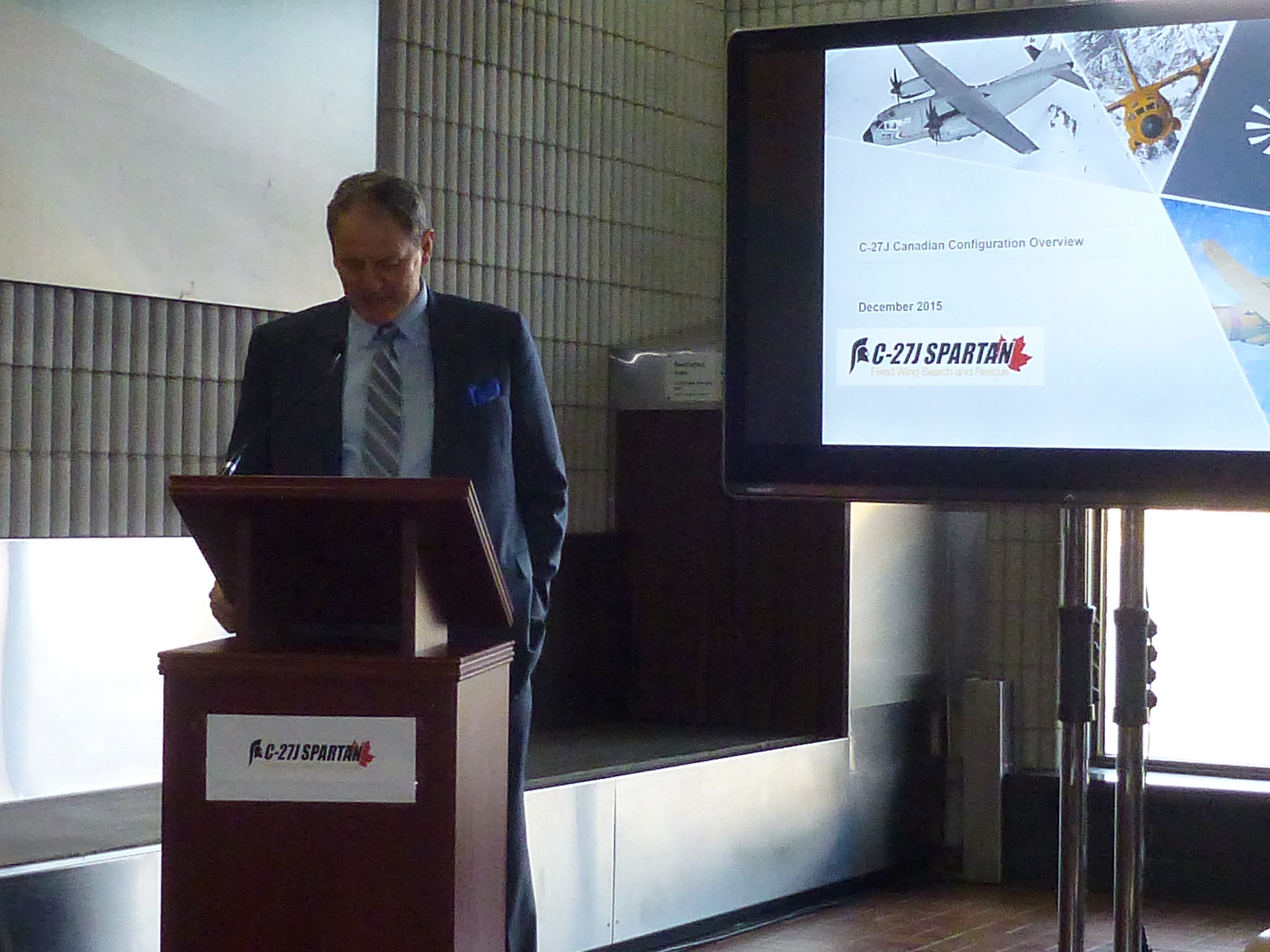
Steve Lucas.
Photo: Philippe Cauchi.

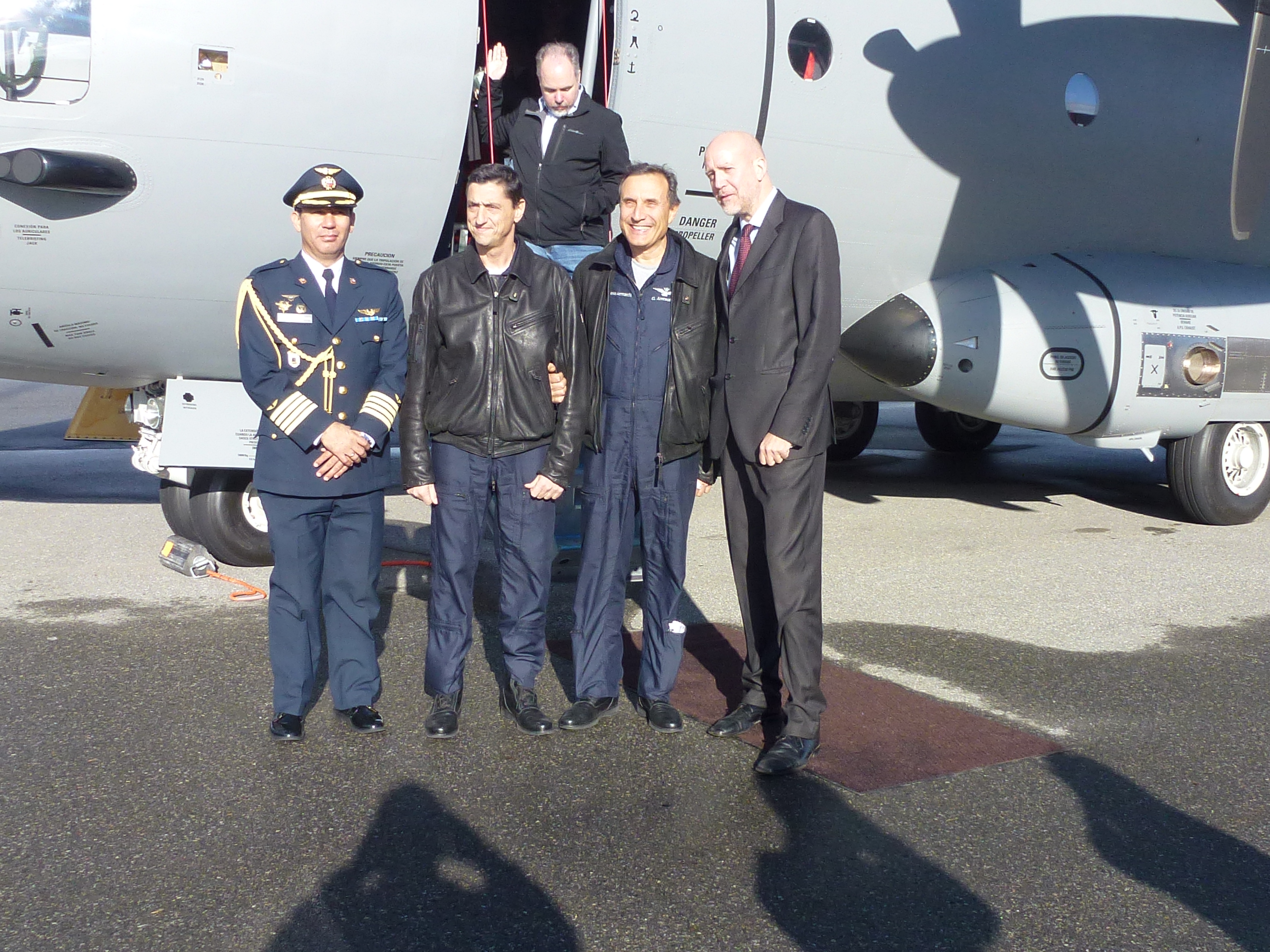
Steve Lucas senior representative for team Spartan and former chief of the Air Staff of the now Royal Canadian Air Force from 2005 to 2007 was flanked by the two C-27J test pilots, Marco Venanzetti and Gianni Ammoniaci who left Turin on thursday afternoon on their way to Peru and the Peru Defence Attaché in Ottawa, Colonel Alejandro Humberto Marusic Caceda, attended.

Mr. Lucas started the press conference by stating that the C-27J, the aircraft of Team Spartan in the Canada’s Fixed Wing Search and Rescue (FWSAR) RFP whose bids are due for January, the 11th, 2016 , is ‘An exceptional aircraft beyond expectations but still within reach of Canada’.


Alenia C-27J Spartan.
Photo: Philippe Cauchi.

In spite of the fact that the C-27J offered to Canada is based on the same configuration that has been supplied to the US Coast Guard, the US Army Special Operations Forces and the Royal Australian Air Force, it will be modified by the Canadian industry in order to ‘make this aircraft right to fulfill the Canadian FWSAR mission’.

The FWSAR will be replacing the six aging De HavilLand CC-115 Buffalo based in Comox, British Columbia and fourteen Lockheed CC-130H Hercules based in Winnipeg, Manitoba (4), Trenton, Ontario (4) and Greenwood, Nova Scotia (3). This process which began more than ten years ago aims to replace theses two fleets of aircraft in service for more than 50 years.

According to Steve Lucas, the C-27J has a rapid response time thanks to its exceptional speed, size, endurance and manoeuvrability enabling it to reach austere and remote locations including theses in the mountains as well as in the far North and the far sea. This way, the C-27J is only aircraft in its class far enough capable to respond by its speed to SAR incidents to the limits of Canada vast SAR area of resposability.

The Canadian RFP underlined Steve Lucas is not a simple replacement on a one-to-one replacement basis of existing aircraft but a very complex set of requirements of thousands of pages requesting that the contender’s aircraft be able :

To respond to three simultaneous SAR incidents in Canada’s three different SAR regions : Victoria SSR, Trenton SSR and Halifax SSR ;

To reach the most remote Canadian location in the shortest time ;

To achieve a 95% availability rate for at least one aircraft in each SSR and a 70% rate for a second one ;

To reach 2674 points in Canada where incidents occured in the last five years.

The size of the cabin of the Spartan is a big plus acording to Mr. Lucas. With a heigth of 2,60 meters, a width of 3,33 meters, and its high floor strength, (4,900kg/mload capability), the cabin allows a lot of activity of moving around in the back, the SAR technicians bringing a lot of equipment.

It is divided in three sections : the mission system section, the storage section and on the ramp, the personnel section.

Photo: Philippe Cauchi.

The C-27J Spartan is not only an aircraft capable to bring the first respondents to site but also to land on short strips and bring back everyone.

Compared to the Buffalo, the C-27J flies faster, further and is pressurized. For this reason, the Buffalo can be used only in the Victoria Region. On top of that, the Spartan have the landing and take off performances of the Buffalo in spite of the weigth of its complete mission system and longer endurance.

Team Spartan C-27J is based on the same configuration of the aircraft supplied to the US Coast Guard which is looking for systems similar to the one installed on the one offered to Canadian Forces. This means opportunities for Canadian suppliers if Canada picks the Spartan.

Steve Lucas recalled that the C-27J is a modern military transport aircraft with an established production line, mature production processes and excellent operational performances.

He concluded by stating that the Spartan is an affordable solution to Canada SAR needs ‘very within reach of Canada with no need to compromise on response time, geographical coverage, crew comfort and cockpit visibility’ and ‘Maximizing Canadian participation and minimizing program risks’.

An advanced derivative of the Aeritalia G222 first flown in 1970, the C-27J is a tactical military cargo aircraft able to perform a variety of missions including transport of troops, logistical resuply, MEDEVAC, air drop operations, paratroopers launches, humanitarian assistance, oil spill relief, fire fighting and SAR.

The C-27J featured the same engines and propellers than the Lockheed Martin C-130J Hercules as well as a common avionics architecture.

Having obtained its Military Qualification Certificate, the C-27J is also airworthy to civil standards with certification from EASA and FAA.

Certification of the C-27J Spartan included cold weather flight testing in Finland.

More than 82 C-27J had beeen ordered by the air forces of Italy, Greece, Bulgaria, Lithuania, Romania, Morocco, Mexico, Australia, Chad, Peru, Slovak Republic, an undisclosed African customer as well as the US Army Special Operations Command and the US Coast Guard.

First Ukrainian Company nears end of training cycle under CAF OP UNIFIER


DND Press Release: 

The last seven weeks have been leading up to the final set of exercises for the Ukrainian infantry company from the 30th Mechanized Battalion currently training under the mentorship of their Canadian Armed Forces partners.

After hours spent in classrooms and in the field, the Ukrainian trainees enter the final set of exercises meant to confirm all of the training that has been conducted under Op UNIFIER at the International Peacekeeping and Security Centre in Starychi, Ukraine.
Canadian and Ukrainian soldiers
CAF Members work along side members of the Ukrainian Military during a training exercise, part of OP UNIFIER. November 25, 2015. Photo: CAF Combat Camera
“The past two months have seen a real exchange of skills and ideas between Canadian and Ukrainian soldiers,” said Lieutenant-Colonel Jason Guiney, Commander Joint Task Force Ukraine. “It is rewarding to see the first serial of training come to a successful end and I believe the soldiers that have undertaken this training will be better prepared for operations than they were eight weeks ago.”

These exercises are aimed at the platoon level and include both mechanized and dismounted live-fire ranges involving the Ukrainian Armed Forces Boevaya Mashina Pehoty-2 (BMP-2) Infantry Fighting Vehicles and a numerous of other weapon systems employed by them.

“The enthusiasm of the Ukrainians has been very high and they have developed a better understanding of how to employ their BMPs in platoon level operations. I believe they are better off now than before undertaking this training” said Lieutenant-Colonel Jason Guiney.

The instruction has been varied, continuous and has confirmed the value of the training package delivered by the CAF contingent. The training provided also included elements on weapons handling, first aid, artillery and mechanized infantry training.

“We started with basic gateway and refresher training,” said a Canadian infantry Sergeant who specializes in mechanized operations, “and as time moved on, we were able to incorporate mechanized and dismounted infantry tactics.”

While the final series of exercises is designed to confirm the skills learned by the Ukrainian soldiers, the CAF instructors are already scheduled to start training with a fresh Ukrainian infantry company.

The partnership between Canadians and Ukrainians continues to grow. The lessons and experiences learned over the past few months will be applied to the upcoming phase of training, as part of a multinational training effort, the Joint Multinational Training Group – Ukraine.

Operation UNIFIER is Canada’s contribution to support Ukrainian forces through capacity building, in coordination with the U.S. and other countries providing similar training assistance.