Translate

Tuesday, April 3, 2018

Danish Arctic Patrol Ship coming to Halifax

By: David Pugliese, Defence Watch 


Representatives from Canada’s defence industry are being invited to tour a Danish Arctic patrol ship that will be in Halifax April 4-5.

The EJNAR MIKKELSEN (EJMI) is one of three KNUD RASMUSSEN-class Arctic vessels, supplementing the four units of the larger THETIS-class, Lt. Col. Per Lyse Rasmussen of the Danish embassy in Washington, pointed out to Canadian industry.

The ship is similar in design to Canada’s Arctic Offshore Patrol Ships being built by Irving but it is smaller. What is also significantly smaller is the cost. Each AOPS is estimated to cost $700 million. The Danish ships are estimated to cost $70 million to $80 million each.

Here are some more details about the ship provided by Rasmussen to Canadian industry representatives:

EJMI is primarily used in the Arctic and specifically in the waters around Greenland as an Arctic Patrol Vessel. Main missions are surveillance, sovereignty enforcement, search and rescue, fishery protection and support to the local community. Other tasks include environmental monitoring, assistance to research and scientific studies, navigational tasks, ice reconnaissance, collection of weather and oceanographic data, icebreaking, explosive ordinance disposal and transportation of personnel and materiel. Additionally, EJMI also offers assistance to Greenland’s Home Rule Government, the Danish Meteorological Institute, the National Police of Denmark, Customs Authorities and many others.

Some useful facts about EJMI, which was named 13 September 2008 after one of the Danish polar explorers:

Length (total): 71,80 meters

Beam: 14,60 meters

Draught: 4,95 meters

Displacement (standard): 2,050 tonnes

Engines: Two MAN diesels 7.770 hp, three generators

Speed (eco): 12 knots

Speed (max): 17 knots

Icebreaking capability: about 3 feet (up to 5 feet)

Basic crew: 19 (up to 43/45)

Range at 12 knots: 7,050 nm

Container positions: 4 standard flex

Weaponry: One 3-inch Oto Melare gun, two 50-cal heavy machine guns, two light machine guns

Other facilities: Flight deck, hospital, SAR-vessel, RHIBs.

Photos Courtesy of the Danish Navy. 

Canadian Helicopters Bound for Mali Could See Combat

By: Lee Berthiaume, The Canadian Press 

The six military helicopters that Canada plans to send to Mali could be used to move more than peacekeepers: they could be called upon to support a multinational counterterrorism force also operating in the country.

The six military helicopters that Canada plans to send to Mali could be used to move more than peacekeepers: they could be called upon to support a multinational counterterrorism force also operating in the country.
THE CANADIAN PRESS
The UN Security Council in December authorized the peacekeeping mission in Mali to provide assistance to the Group of Five (G5) Sahel, a military force comprised of troops from five African nations.

That assistance includes medical evacuations for combat and noncombat injuries as well as the provision of fuel, water and rations – exactly what the Canadian military helicopters due to arrive in Mali in August will be configured to do.

The Trudeau government made no mention of the G5 Sahel when it announced its decision last month to send helicopters to Mali, and the Defence Department declined to comment on whether Canada would support the force.

“Details remain to be determined as negotiations with the United Nations have yet to begin,” spokeswoman Jessica Lamirande said in an e-mail.

“Specifics regarding the exact CAF contribution, and how that CAF contribution will be used, are some of the many factors that will be addressed during upcoming reconnaissance and negotiations with the United Nations.”

But the revelation has sparked renewed opposition calls for the Liberal government to provide more information about what the Canadian military is walking into in Mali.

“There’s just so many holes and unanswered questions about mission that we’re still very apprehensive,” said Conservative defence critic James Bezan, whose party has demanded a debate and vote on the mission.

“The Liberals say there won’t be necessarily boots on the ground, but they’re going to be moving boots on the ground back and forth from the conflict zone.”

The G5 Sahel, whose members include Burkina Faso, Chad, Mauritania, Niger and Mali, has been tasked with fighting jihadists and transnational crime groups across a large swath of West Africa south of the Sahara desert.

The force was the brainchild of France, which has been conducting counterterror operations in Mali and the region since 2012, and enjoys financial backing from France, the U.S., the European Union and others.

But the 5,000-strong force’s first operation in November was plagued by logistical problems, and it remains very much a work in progress despite political support from a variety of powers including Russia and China.

It was in that context that the UN Security Council passed a resolution Dec. 8 emphasizing the G5 Sahel’s role in bringing security to the region and authorizing the UN mission in Mali provide support to the African force.

An agreement between the UN, EU and G5 Sahel members to provide operational and logistical support to the force through the United Nations Multidimensional Integrated Stabilization Mission in Mali, or MINUSMA, was signed in February, a UN spokesperson said.

Security Council members specifically authorized the provision of medical evacuations, including those related to combat and other malicious acts, as well as fuel, water and rations and engineering services to the G5 force.

Such support is to be restricted to Mali, in accordance with the UN mission’s own boundaries, and only when it won’t negatively affect the peacekeeping mission’s own operations.

Royal Military College professor Walter Dorn, one of Canada’s pre-eminent experts on peacekeeping, found himself hard-pressed to think of another UN mission whose mandate included supporting a counterterrorism mission.

There could be a higher risk for Canadian military personnel if they are asked to evacuate injured G5 troops from a battle, Dorn acknowledged, though he said the UN is protective of its helicopters.

“While there may be circumstances where the helicopters could be flying into a conflict, in most cases the helicopters will be landing in secured landing zones,” he said.

“The procedure will be that the forces on the ground have to secure a landing zone for them for an evacuation to take place. The UN doesn’t want to lose a helicopter, particularly on a G5 or non-UN mission.”

Canada could also tell the UN that it doesn’t want its helicopters to support the G5 force.

But the UN typically pushes back against countries imposing restrictions on how their troops and equipment can be used on missions, as such caveats have been blamed for some of the peacekeeping disasters of the 1990s.

The fact Canadian troops could end up supporting counterterror operations nonetheless came as a shock to NDP defence critic Randall Garrison, who blasted the Liberals for not telling Canadians more about the Mali mission.

“It falls on the Liberals to tell us what they actually intend for this mission to do,” Garrison said. “What role will it play? What are the parameters? They haven’t given us anything.”

Wednesday, March 28, 2018

RCN Reservists Experience life on New Zealand Warship


By Darlene Blakeley

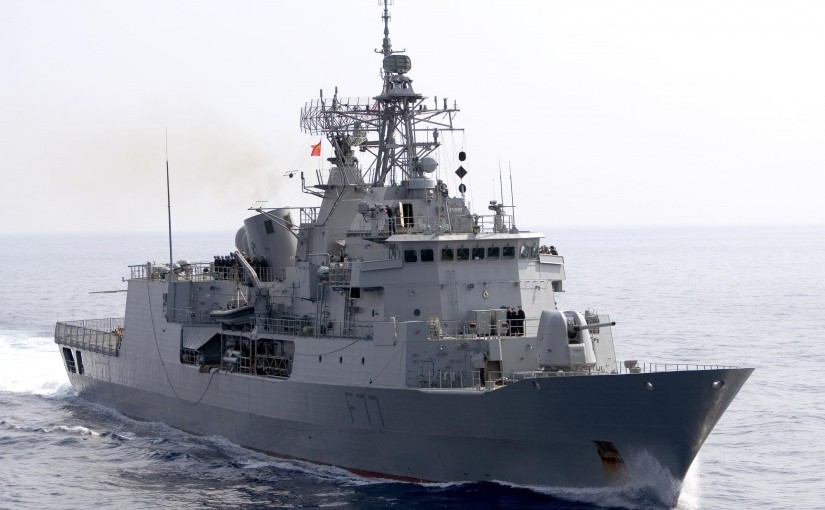
Eleven members of Canada’s Naval Reserve are experiencing a once-in-a-lifetime opportunity to see first-hand what service is like in a Royal New Zealand Navy (RNZN) warship.

Nine bo’suns and two cooks from Naval Reserve Divisions across the country are sailing aboard the RNZN’s Anzac-class frigate Te Kaha as it transits from Honolulu, Hawaii to Victoria.

Image result for RNZN Te Kaha
The New Zealand Navy RNZN Te Kaha
The sailors joined the ship as part of the REGULUS program, which facilitates exchanges with partner navies from around the world, providing unique training opportunities and exposing sailors to the diverse cultures of allied navies. While sharpening sailors’ skills, the REGULUS program also helps strengthen relationships with allied nations, increasing interoperability and reinforcing the Royal Canadian Navy’s commitment to international peace and security.

Master Seaman Kaitlin Braithwaite from the Naval Reserve Division HMCS Prevost in London, Ont., was the catalyst for this group’s deployment. While working and training as a civilian primary school teacher in Auckland, NZ, she was given the opportunity to consolidate her skills as a bo’sun in the Naval Reserve as well. Through the REGULUS program, she requested and was authorized to sail aboard the Te Kaha when it departed Devonport, NZ, en route to Victoria where it will be undergoing a frigate system upgrade.

“Joining a new ship is always a bit daunting but I could not have been welcomed any better,” she says. “Every sailor welcomed me on board and helped me become a member of the crew.”

MS Braithwaite was able to join the RNZN gunners (similar to bo’suns) on bridge watches and says that functions such as lookouts and officer-of-the-watch duties are the same.

“However, once we left New Zealand there was not much for the lookout to see – open ocean with no contacts for over nine days,” she says. “All of my experience sailing in Canada has been on the Kingston-class maritime coastal defence vessels, which mainly keep to the coast for calmer waters. As soon as we departed New Zealand it was a straight course north to Canada experiencing sea state seven [six to nine metre waves].”

By mid February, Te Kaha had come alongside Pearl Harbour Naval Base in Honolulu en route to Canada.

“This was a welcome R&R stop that showed me just how welcoming the New Zealand navy could be. Their crew was always planning activities such as surfing, sky diving, and cage diving,” explains MS Braithwaite.

It was in Honolulu that 10 additional naval reservists joined MS Braithwaite in the ship as part of the REGULUS program.

“I was happy to see some familiar faces and was encouraged that I could help them adjust to ship life onboard the Te Kaha,” she says.

She explains that the name “Te Kaha” is Maori, meaning “fighting prowess” or “strength.” The ship’s motto is “He Ponanga Kaha” or “Service with Strength”, embodying the strength of the ship, the RNZN and service to country.

“This experience has shown me that even though thousands of nautical miles separate New Zealand and Canada, we are much the same,” says MS Braithwaite. “Our values and traditions as sailors translate across oceans.”

Her time with the crew of Te Kaha ended when the ship reached Victoria on March 5, but, she says, “The new friendships and lessons I learned while onboard Te Kaha will last a lifetime.”

Lord Strathcona’s Horse return to Moreuil Wood for 100th Anniversary

By Steven Fouchard, Army Public Affairs
"Charge of Flowerdew's Squadron"
"Charge of Flowerdew's Squadron" by Sir Alfred Munnings, 1918. Canadian War Museum - 19710261-0443
Moreuil, France — Current members of Lord Strathcona’s Horse (Royal Canadians) are returning to France to mark the centenary of a First World War battle in which one of their number earned a posthumous Victoria Cross (VC).

The commemoration begins March 30, 2018 when the Strathconas, as they are also known, will parade and re-enact the battle.

Additionally, the Town of Moreuil will grant the unit Freedom of the City on March 31. Freedom of the City is a tradition dating back to the Wars of the Roses, a 13th century conflict that pitted powerful British families against one another for the throne. Municipal officials of the time would meet with the commanding officers of units seeking entry and, once their intentions were determined to be friendly, the units would be invited to march through the city streets.

The unit more than lived up to its motto, ‘Perseverance,’ at Moreuil Wood where they and the other troops that made up Canadian Cavalry Brigade (CCB) faced a German offensive on March 30, 1918.

With British units in withdrawal, the CCB was called upon to face the enemy near the French town of Moreuil. With the rest of the CCB engaged with the Germans in the wood, a squadron led by Strathcona Lieutenant Gordon Muriel Flowerdew moved to the northwest corner of the battlefield to stop enemy reinforcements from entering the battle.

The 100-strong squadron discovered a German force of 300 bolstered by machine guns. Despite the overwhelming firepower, Lt Flowerdew led the squadron in a charge, reputedly shouting, “It’s a charge, boys, it’s a charge!”

He led two charges that caused the Germans to withdraw. The squadron suffered 70 per cent casualties and LtFlowerdew sustained wounds that would kill him the next day. “There can be no doubt that this officer’s great valour was the prime factor in the capture of the position,” his VC citation reads.

The action is also notable historically for being one of the last documented horse-mounted charges, which were falling out of style with military tacticians by the early 20th century.

HMCS Chinoutimi Celebrates Achievements in the Asia-Pacific Region


By Darlene Blakeley, The Maple Leaf 

Her Majesty’s Canadian Submarine (HMCS) Chicoutimi has piled up a lot of firsts on its lengthy deployment to the Asia-Pacific region.
HMCS Chicoutimi sails with ships of the U.S. Navy and the Japanese Maritime Self-Defence Force during ANNUALEX.

It’s the first time a Victoria-class submarine has deployed from the Royal Canadian Navy (RCN) to the region; been deployed for so long – nearly 200 days; participated in the previously bilateral ANNUALEX with the U.S. Navy (USN) and the Japanese Maritime Self-Defence Force (JMSDF); and made port visits to Yokosuka and Sasebo, Japan and Guam.

“Normally we have to take a submarine out of the water to change batteries, but this time we were able to do it safely in the water thanks to the expertise of Fleet Maintenance Facility Cape Breton.” — Captain (Navy) Chris Robinson

It’s also the first time a Victoria-class submarine has undertaken a large-scale deployed maintenance activity conducted by personnel from Maritime Forces Pacific (MARPAC) and Fleet Maintenance Facility Cape Breton (FMFCB) in Japanese ports – all while Super Typhoon Lan raged around them.

“It has been a phenomenally successful deployment,” says Captain (Navy) Chris Robinson, Commander of the Canadian Submarine Force.

HMCS Chicoutimi, under the command of Commander Stephane Ouellet, left its home base in Esquimalt, B.C., in early September last year. Its simply stated mission was to “support Canada’s global engagement strategy through strategic partnerships, port visits and operational interactions.”

But it has been anything but simple. Over the course of several months, Chicoutimi conducted intelligence, surveillance and reconnaissance; carried out seven interactions with the USN, JMSDF, the French Navy, the Royal Air Force and the Royal Australian Air Force; operated with more than 20 surface ships and 50 aircraft; and conducted more than 180 hours of submarine-on-submarine engagements.

The success of this hectic tempo is a testament to the crew, according to Capt(N) Robinson, who says they worked hard and overcame challenges prior to deploying. In particular he mentions the unexpected swapping out of the submarine’s main battery last May.

“The battery, the lifeblood of a submarine, was functioning below performance specifications,” Capt(N) Robinson explains. “Normally we have to take a submarine out of the water to change batteries, but this time we were able to do it safely in the water thanks to the expertise of Fleet Maintenance Facility Cape Breton. It enabled us to get back to work much more quickly.”

One of the highlights of Chicoutimi’s tour has been the ability to gain a greater understanding of the challenges facing the deployment of a Victoria-class submarine to a distant, strategically important area.

“We had very complex logistic and maintenance arrangements with partner nations that we navigated throughout the deployment,” says Capt(N) Robinson. “We gained a much better understanding within the RCN of the multi-faceted logistical arrangements needed when supporting a deployed submarine.”

Successful routine maintenance was carried out in Japanese ports, with USN support. More than 30 personnel from FMFCB conducted over 1,800 hours of maintenance in eight days. Additionally, there was a month-long maintenance period in Guam, the first deployed submarine short-work period ever conducted by MARPAC and FMFCB. During this time significant repairs were made to fridge and hydraulic plants, diesel engines and motor generators.

Capt(N) Robinson is quick to praise both FMFCB and a deployed joint logistic coordination cell from Esquimalt.

“They provided stellar support in moving both parts and people,” he says. “They also overcame significant challenges in moving military gear in and out of Japan. This has enabled us to learn valuable lessons for future deployed submarine work periods.”

Capt(N) Robinson says one of the most rewarding aspects of the deployment has been building relationships with both the USN and the JMSDF.

“These strategic partnerships are built on trust and experience working together in major ways,” he says.

Chicoutimi developed increased interoperability with the USN’s Seventh Fleet and forged strong bonds with the JMSDF. For the first time a Canadian submarine participated in ANNUALEX, normally a bilateral exercise between the USN and JMSDF. It is carried out every year in the Southern Sea of Japan to practise and evaluate the coordination, procedures and interoperability elements required to effectively respond to the defence of Japan or to a regional contingency in the Indo-Asia-Pacific.

“This was a major achievement and a real manifestation of Canada’s defence policy ‘Strong, Secure, Engaged’,” Capt(N) Robinson explains. “It represents a clear indication of the RCN’s commitment to peace and security in the region, and shows that our navy is fully engaged and able to project sea power far from Canada’s shores.”

Chicoutimi’s prowess did not go unnoticed by the USN. “Chicoutimi has provided exceptional support for the 7F (Seventh Fleet) team during the past few months and I sincerely appreciate all of the work to make its deployment happen. Hopefully 2018 will bring even more,” says Vice-Admiral Phillip Sawyer, Commander of the Seventh Fleet.

Over the course of this historic deployment, the 59 crew members have been exceptionally busy. They have been able to qualify 50 per cent of new submarine crew and progress several higher level qualifications, all while conducting operations.

“Through it all the crew has been enthusiastic and morale has been very good,” says Capt(N) Robinson. “The families back home have also been incredibly supportive of this long deployment.”

Unlike surface ships, submarines have no way to communicate with family and friends while submerged, except through coded “familygrams” once a week.

“This is always a challenge,” says Capt(N) Robinson. “There is no phone and no internet while the boat is under water.”

During port visits communications can take place as usual, and families can also get information through the Military Family Resource Centre in Esquimalt.

As Chicoutimi arrives home, crew members are looking ahead to some time off before the submarine continues operations later this year.

“They can take great pride in knowing that they have contributed to maritime peace and good order abroad by patrolling, building strategic relationships and interacting with our partner nations,” says Capt(N) Robinson. “It has been an exceptional deployment on so many levels.”