Translate

Tuesday, November 20, 2018

Government Rejects Advice to Replace Victoria-Class Submarines

By: David Pugliese, The Ottawa Citizen 

New submarines won’t be part of the future mix for the Royal Canadian Navy, at least in the foreseeable future.

Several years ago there were some suggestions that a possible replacement for the Victoria-class submarines might be in the works. In 2017 a Senate defence committee recommended the subs be replaced.

The Commons defence committee also recently recommended that the Victoria-class subs, bought used in 1998 from the United Kingdom, be replaced with submarines capable of under-ice capabilities.

But the Liberal government has rejected that recommendation. The recommendation was the only one of the 27 made by the Commons defence committee that was rejected outright in a response delivered to the committee last month.

The committee had recommended that the federal government respond to NATO calls to improve the quality of their naval fleets and underwater surveillance capabilities by starting the process of replacing Victoria-class submarines with new boats that have under-ice capabilities. It also recommended increasing the size of that fleet to enhance Canada’s Arctic and North Atlantic defence preparedness.
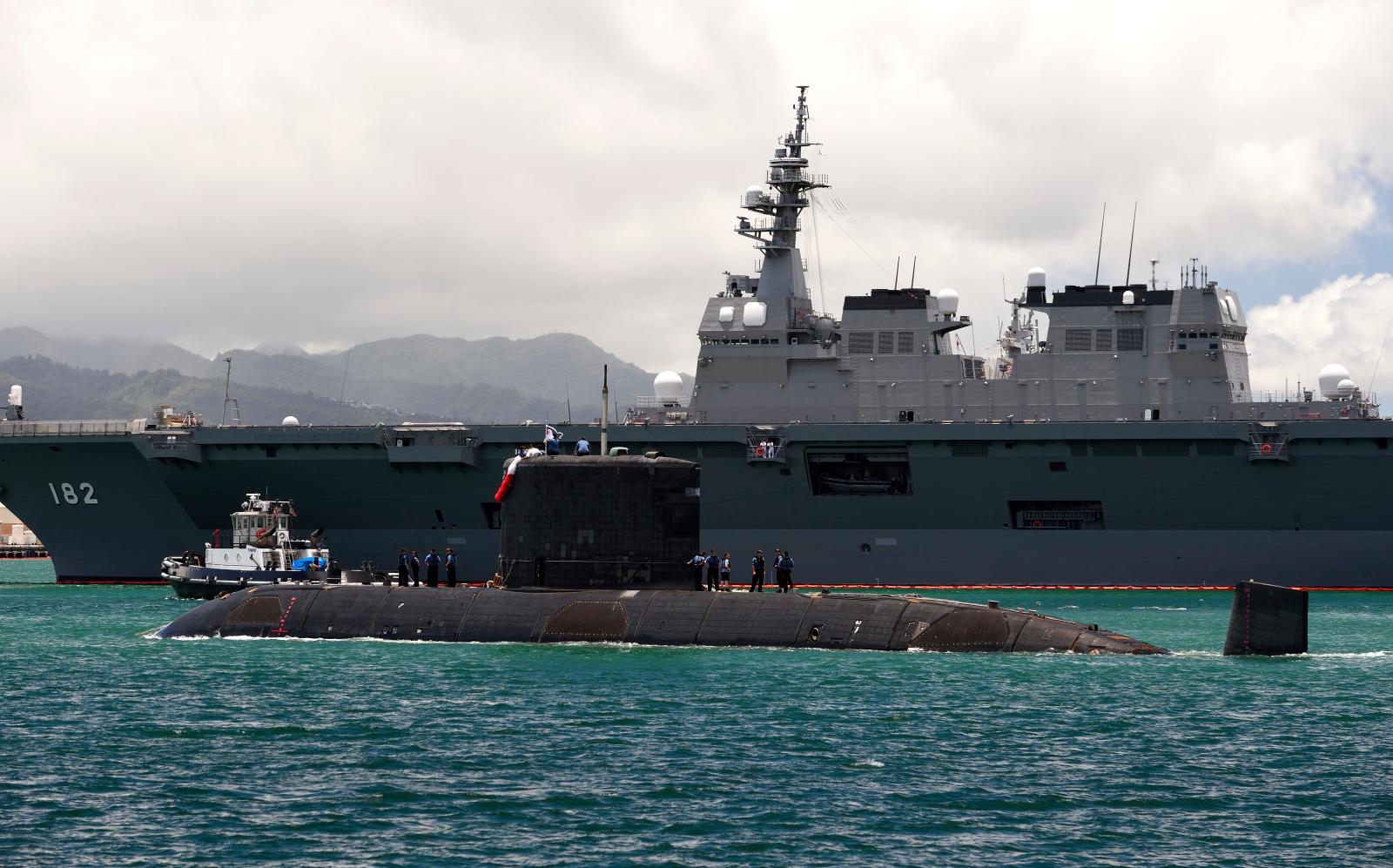
Image result for victoria-class submarines
HMCS VICTORIA sails past the Japanese Ship ISE as she arrives in Pearl Harbor on July 1, 2014 to take part in Exercise Rim of the Pacific (RIMPAC).
But the Liberal government pointed out in its response that it is in the midst of the most intensive and comprehensive fleet modernization and renewal in the peacetime history of the Royal Canadian Navy. Canada is recapitalizing and increasing the size of its surface fleet through investments in 15 Canadian Surface Combatants, two Joint Support Ships, and five to six Arctic and Offshore Patrol Ships, it added. “The government has also committed to modernizing the four Victoria-class submarines to include weapons and sensor upgrades that will enhance the ability of the submarines to conduct Intelligence, Surveillance and Reconnaissance (ISR) and deliver necessary improvements of platform and combat systems to extend operational capability to the mid-2030’s,” the government response noted.

Canada is also engaged in the re-building of the anti-submarine warfare capabilities of the fleet through the introduction of technologies, sensors and weapons while preparing to transition to the fleet of the future, it added. “As part of the NATO S&T Organization, Canada is participating in the Maritime Unmanned Systems S&T Pre-Feasibility Studies that focus on ASW and naval mine warfare capabilities with Allied nations that have the same capability targets,” the government stated. “In addition to increasing existing platform capabilities, the RCN is also in the process of re-vitalising individual and collective ASW training and advancing distributed mission training and synthetic training environments.”

Last year Defence Minister Harjit Sajjan praised the capability submarines provide Canada. “No other platform in the Canadian Armed Forces can do what a submarine can do,” Sajjan said. “No other platform has the stealth, the intelligence-gathering, surveillance and reconnaissance capability and the deterrence to potential adversaries that a sub does.”

Upgrading the Victoria-class subs is more “prudent” than buying new subs, Sajjan said at the time.

Without upgrades, the first of the submarines will reach the end of its life in 2022, according to documents obtained last year through Access to Information by the Canadian Press. The last of the boats would be retired in 2027.

RCAF Members Arrive in Brazil for Exercise CRUZEX FLIGHT

RCAF Press Release 

8 Wing Trenton

Today, members of the Royal Canadian Air Force (RCAF) begin participation in CRUZEX FLIGHT 18, a key South American multinational exercise hosted by the Brazilian Air Force.

The RCAF joins its allies and partners from Brazil, Chile, Colombia, Peru, France, the United States and Uruguay, as they exercise tactical transport missions in conflict and humanitarian relief scenarios in a combined environment, while exchanging information on doctrine.

Two large propeller-driven aircraft rest on a runway.
Two Royal Canadian Air Force CC-130J Hercules from 436 Transport Squadron arrive in Natal, Brazil, for CRUZEX FLIGHT 18, on November 18, 2018. The key South American exercise brings together air forces from eight allied and partner nations to conduct a wide range of training. PHOTO: Able Seaman Paul Green, TN05-2018-0500-001

Two CC-130J Hercules aircraft and more than 35 members of the RCAF from 8 Wing Trenton, Ontario; 1 Canadian Air Division; and RCAF headquarters will be participating in the exercise from November 18 to 30. The two Hercules are from 436 Transport Squadron. Members of the Canadian Army Advanced Warfare Centre will also take part.

In line with Canada’s Defence Policy—Strong, Secure, Engaged—Canada remains committed to working with its allies and partners in the Americas to increase capabilities, foster military professionalization, and encourage interoperability. As such, the RCAF continuously works to nurture and deepen existing partnerships, as well as create new ones. Enhancing defence diplomacy in the Americas serves to strengthen international and regional security, while also supporting continental, NATO and UN led-missions.

“We look forward to our participation in CRUZEX FLIGHT 18,” said Lieutenant-Colonel Andy Bowser, the CRUZEX FLIGHT 18 air task force commander. “In addition to flying tactical missions, the Air Task Force members will also engage in academic discussions regarding Peace Support Operations, thereby building relationships with our partner nations and contributing to capacity building in the region.”

Exercising in unfamiliar environments contributes to the operational readiness of air mobility aircrew and technicians as these personnel may be called upon to fly anywhere in the world to support Canadian Armed Forces operations, including humanitarian relief missions.

Defence diplomacy in the Americas is a key initiative of Strong, Secure, Engaged, and Brazil is one of the Government of Canada’s priorities for engagement in the Western Hemisphere. The RCAF has had a bilateral relationship with the Brazilian Air Force (Força Aérea Brasileira) since 2009 and conducts biennial deputy commander-level staff talks.

Participation in CRUZEX FLIGHT 18 demonstrates Canadian commitment to the Americas and provides an opportunity to demonstrate leadership in areas such as capacity building, humanitarian assistance and disaster response, and support for other government departments in their efforts to counter the illegal movement of drugs, people, weapons, money and other transnational organized crime activity.

The CC-130J is a four-engine, fixed-wing turboprop aircraft that can carry up to 92 combat troops or 128 non-combat passengers. It is used for a wide range of missions, including personnel transport, tactical airlift (both palletized and vehicular cargo) and humanitarian aid delivery.

RCAF - No Documented Fighter "Gap" Evidence

By: David Pugliese, The Ottawa Citizen 

Neither Canada’s top soldier nor the commander of the air force had or produced any records about a fighter jet “capability gap” in the year leading up to the Liberal government’s announcement that such a critical issue had to be dealt with by spending billions to buy aircraft.

Defence Minister Harjit Sajjan used the capability gap argument in November 2016 to justify a $5-billion program to buy new Super Hornet jets, a deal since scuttled, and later a $500-million program to purchase used F-18 planes from Australia.

But in the year leading up to Sajjan’s announcement about the urgent need to acquire such planes, neither Chief of Defence Staff Gen. Jon Vance nor Lt.-Gen. Mike Hood, then head of the Royal Canadian Air Force, produced any documentation indicating there was ever a capability gap, according to Department of National Defence’s Access to Information branch. In addition, no such documents exist among the records of various members of Sajjan’s staff, according to the department.
A Royal Australian Air Force F-18 Hornet performs during the Australian International Airshow in 2015.PAUL CROCK/AFP/GETTY IMAGES

It would be normal practice to have hundreds, if not thousands of pages of records, discussing such a key defence issue or gap if it existed, military insiders tell Postmedia.

But records obtained by Postmedia through the Access law do show that just before Sajjan’s announcement that the 18 jets were needed in the “interim” to deal with the capability gap, the minister was told the existing fleet of CF-18s was in better shape than expected and could keep flying until 2032.


Conservative MPs allege the capability gap didn’t exist and was concocted by the government to delay a larger project to buy new jets, a competition that might end up selecting the F-35 stealth fighter the Liberals vowed never to purchase.

When asked about the lack of documentation about the capability gap, a DND official said the department could not comment.

Taxpayers may get more information Tuesday when the Auditor General’s office releases its examination of the fighter jet plan.

The deal to buy the 18 Super Hornets as “interim” jets eventually collapsed after the aircraft’s U.S. supplier, Boeing, angered the Liberals by complaining to the Trump administration that a Canadian firm was receiving unfair subsidies to build civilian aircraft. Because of that complaint, the government deemed Boeing an unreliable partner and instead struck a deal to buy used F-18 jets from Australia. That project is estimated to cost $500 million.

Those jets are needed on an interim basis not only to help fill the capability gap but because the current fleet of CF-18 fighters is too old, the government has stated.

But nine days before Sajjan held his November 2016 news conference to announce the original Super Hornet interim jet deal, the minister was told the CF-18 fleet was in better shape than expected.

“Analysis over the summer indicates that the structural damage is less than anticipated and that all aircraft can be flown and retired at a predicted rate beyond 2025 without additional investment in structural work,” Sajjan was told by deputy defence minister John Forster. “Doing so would require an investment to 2032 (when the last legacy aircraft would retire).”

Shortly after Sajjan’s news conference, Hood explained to a Senate committee it was the government that brought in a policy change that required the RCAF to meet both its NATO and North American air defence commitments at the same time. That, in turn, created the capability gap.

“That demands a certain number of aircraft that our present CF-18 fleet is unable to meet on its day-to-day serviceability rate,” said Hood, who has since retired. “They’ve (the Liberals) changed the policy of the number of aircraft I have to have.”

Hood said he didn’t know the reason for the change. “I’m not privy to the decisions behind the policy change,” added the general.

In addition, a 2014 report produced by Defence Research and Development Canada recommended against the purchase of such “bridging” aircraft to deal with gaps in capability. “The costs involved with bridging options make them unsuitable for filling capability gaps in the short term,” the report states. “Any short-term investment results in disproportionately high costs during the bridging period.”

That report, which had been in the public domain for years, was removed from the DND website. The DND claimed it was pulled down from its website because the report was found to contain classified information.

Auditor general takes aim at Liberals' fighter-jet plan with new probe

By: Lee Berthiaume, The Canadian Press - Published to BNN Bloomberg 

OTTAWA -- Six years after helping blow up the Harper government's plans to buy F-35 stealth fighters without a competition, auditor general Michael Ferguson is about to release a new report on Canada's tumultuous attempts to buy new fighter jets.

This time, the focus will be on the Trudeau government's handling of the file, which includes adopting several stopgaps while taking its time on a competition to buy new planes for the Canadian Forces.

Ferguson is expected to report specifically on the financial and technological costs of flying Canada's venerable CF-18s -- plus a handful of second-hand Australian jets -- into the early 2030s, when the aircraft will be nearly 50 years old.

The auditor general is also expected to train a spotlight on the air force's problems recruiting and retaining fighter pilots, the question of whether Canada has enough jets to defend itself -- and whether the Liberals followed procurement laws.

Ferguson's report follows several years of criticism over the Trudeau government's decision not to launch an immediate competition to replace the CF-18s, which started flying in the 1980s and were supposed to be retired by 2020.

It has been highly anticipated in political and defence circles given the damage that Ferguson's previous report on fighter jets dealt to the Conservatives and because of the shroud of secrecy that has surrounded the Liberals' decision-making on the file.

The Trudeau government has forced hundreds of federal civil servants and contractors working on the fighter-jet project to sign lifelong non-disclosure agreements, while many documents associated with the issue have been declared cabinet secrets.

Canada's attempts to buy fighter jets have dragged on for nearly a decade since the previous Conservative government announced in 2010 that Canada would buy 65 F-35s without a competition, with the first to be delivered in 2015.

The Tories pushed the reset button in 2012 after Ferguson released a scathing report that found defence officials twisted procurement rules and misled Parliament. National Defence later revealed the jets would cost $46 billion over their lifetimes, much more than the sticker price.

The Trudeau Liberals waded into the issue in the 2015 election when they campaigned on a promise to hold an open and fair competition while at the same time vowing not to buy the F-35s.

But rather than launch a competition right away, as many suggested, the Liberals said in November 2016 that they would wait until 2019. In the meantime, they planned to use a hole in the federal procurement laws to buy 18 "interim" Super Hornets without a competition.

The Liberals said at the time that the Super Hornets were urgently needed because Canada did not have enough CF-18s, but opposition parties and several retired military officers accused the government of bending the rules and wasting taxpayer dollars just to avoid buying the F-35.

They demanded the government launch an immediate competition to replace the CF-18s rather than wait; the government insisted more time was necessary to ensure due diligence and a successful procurement after years of trouble.

The government ultimately scrapped the plan to buy Super Hornets from Boeing for more than $6 billion due to a trade dispute between the U.S. aerospace giant and Montreal rival Bombardier.

But rather than launch a competition, it announced plans to buy 25 second-hand fighter jets from Australia for around $500 million.

The $19-billion competition to replace the CF-18s is slated to begin officially in the spring, though a winner won't be selected until 2021 or 2022. Delivery of the first of 88 planes is scheduled for 2025, with the last due in 2032.

The F-35 has been allowed to compete, despite the Liberals' election promise not to buy it. It is up against the Super Hornet as well as two European designs: the Eurofighter Typhoon and Saab Gripen. A French company with a fifth option dropped out last week.

In the meantime, the government is looking to spend upwards of $1.5 billion to keep the CF-18s and Australian fighters in the air long enough for the new planes to be delivered.

Defence analyst David Perry of the Canadian Global Affairs Institute said they key question leading up to the report's release is what impact it will have on the Liberal government and Canada's attempts to buy a new fighter jet.

"I hope it doesn't set back our fighter program by another 10 years," he said. "Because what the auditor general found -- and the way it was interpreted last time -- set the fighter-jet program back by a decade."

Monday, October 22, 2018

British firm BAE Selected for Canada’s $60B Warship Replacement Program

By: David Pugliese, The National Post 

The Canadian Surface Combatant project will see the Halifax-based Irving build 15 warships, which will form the backbone of the future Royal Canadian Navy.


Artists Rendition of an RCN BAE Type 26 Global Combat Ship. BAE Handout
The Canadian government has selected a consortium closely linked to Irving Shipbuilding to provide it with a new warship design for the most expensive defence project the country has ever seen.

Canada announced Friday it had chosen the Type 26 warship design by British defence firm BAE for the $60-billion program to replace the Royal Canadian Navy’s Halifax-class frigates. Lockheed Martin Canada is leading the BAE consortium and will be the prime contractor. The group’s win had been anticipated since 2016, however, after rival defence firms raised concerns that the competition had been rigged in favour of the British design.

The Canadian Surface Combatant project will see the Halifax-based Irving Shipbuilding build 15 warships, which will form the backbone of the future Royal Canadian Navy. It will be the largest and most complex procurement in Canadian history. However, it is seen as a major departure from previous procurement processes, as Irving is playing a significant role in selecting the winning design.

The previous federal procurement minister, Judy Foote, had said only mature existing designs or designs of ships already in service would be accepted for the bidding process, on the grounds they could be built faster and would be less risky — unproven designs can face challenges as problems are found once the vessel is in the water and operating. But the Liberal government and Irving accepted the BAE design into the process, though at the time it existed only on the drawing board. Construction began on the first Type 26 frigate in the summer of 2017 for Britain’s Royal Navy, but it has not yet been completed.
Federal shipbuilding program poorly managed and lacks oversight, government adviser warns
Federal warship replacement cost swells to $62 billion, now more than twice the original budget: PBO
Liberals reject warship proposal that companies said would save taxpayers as much as $32B

Both Irving and the federal government have insisted the procurement was being conducted in a way that ensures all bidders are treated equally, overseen by a fairness monitor with no unfair advantage given to any individual bidder. Nonetheless, while three consortiums submitted bids for the surface combatant program, several European shipbuilders decided against participating because of concerns about the fairness of the process. Others raised concerns about BAE’s closeness with the Halifax firm.


Last year a French-Italian consortium also declined to formally submit a bid and instead offered Canada a fleet of vessels at a fixed price. Officials with Fincantieri of Italy and Naval Group of France said they don’t believe the procurement process as it is currently designed will be successful. The federal government, however, rejected the deal.

The federal government had to remind Irving about the potential for conflict of interest when the firm joined forces with BAE in late 2016 to bid on a multi-billion dollar contract to provide maintenance and support for the navy’s new Arctic patrol and supply ships.

The Irving-BAE alliance was not successful in that bid, but it led the government to remind Irving it had an obligation to “ensure that the Canadian Surface Combatant competition is conducted in a manner that is free from real or perceived conflicts of interest,” according to February 2017 documents prepared for defence minister Harjit Sajjan and released to the Conservatives under the Access to Information law.

Andre Fillion, assistant deputy minister for defence and marine procurement at Public Services and Procurement Canada, said Friday’s decision is not a contract award. “It’s an important step to getting to contract award in the coming months,” he said.

Negotiations will now begin with Lockheed Martin. if negotiations proceed accordingly a contract is expected to be signed sometime between January and March 2019.

But Fillion said if there are issues with those negotiations and an agreement is not reached, the government will then turn to the next highest-ranked bidder. The government has declined to identify that firm, but the other bidders were from the U.S. and Spain.

The Canadian Surface Combatant program has already faced delays and rising costs. In 2008 the then-Conservative government estimated the project would cost roughly $26 billion. But in 2015, Vice-Admiral Mark Norman, then commander of the navy, voiced concern that taxpayers may not have been given all the information about the program, publicly predicting the cost for the warships alone would approach $30 billion.