Canada's special forces kept too many secrets about Afghan missions
Friday, September 7, 2018
August Recap
Welcome back Canadian Forces Dispatch readers. I took an extended break from posting in August, and now that the school year is up and running again; here is what has happened over the past four-weeks. All original reporting is linked to the headline.
Canada's special forces kept too many secrets about Afghan missions
Grounded cruise ship rescue in Nunavut cost Canada's Armed Forces $513K
Craig Manufacturing lands $25 million Canadian Forces contract
Canada's special forces kept too many secrets about Afghan missions

Wednesday, August 1, 2018
On Vacation
I am on Vacation for the first three weeks of August.
New posts will be available between August 27 and September 3.
Thank you for the continued readership.
Friday, July 20, 2018
Final Canadian Surface Combatant Bids Due Today
By: David Pugliese, Defence Watch
The final bids are being submitted Friday by various consortiums for the Canadian Surface Combatant program.
The bids going in Friday involve the finalized portions of the bids on designs (the technical design bids were originally submitted in November but today marks the deadline for responses that deal with any questions the federal government may have had/changes needed to be made) as well as proposals for the financial elements for the project.
The new ships will be the backbone of the future Royal Canadian Navy.
The groups bidding include:
-Lockheed Martin Canada, who will be the prime on the team that includes BAE Systems, CAE, L3 Technologies, MDA, and Ultra Electronics. The team is offering the BAE Type 26 warship for the Canadian program. The proposal will include Lockheed Martin Canada’s combat management system, CMS 330, which is currently on board the modernized Halifax-class frigates. A scaled down version of the system will be used on the Royal Canadian Navy’s new Arctic Offshore Patrol Ship fleet. The United Kingdom is acquiring 8 of the Type 26 ships. Australia has also identified the Type 26 as the design for its future warship.
Gary Fudge, Vice President and General Manager, Lockheed Martin Canada Rotary and Mission Systems told Defence Watch that the group’s bid was submitted earlier this week. He noted that the Type 26 would be excellent in an anti-submarine warfare role as it is designed to be extremely quiet. The vessel also has room to future modernization, unlike older designs, he added. The Lockheed Martin team, which is making $17 billion in value proposition commitments to Canada, will commit to spending billions in innovation across Canada’s priority areas, including $2 billion in supplier development and $2 billion in research and development, and $200 million in advanced manufacturing, the company noted.
-Alion Science and Technology, along with its subsidiary Alion Canada, submitted their proposal based on the Dutch De Zeven Provinciën Air Defence and Command (LCF) frigate. “Our solution delivers an effective, affordable, production-ready 21st century naval capability to meet Canada’s defence needs,” Bruce Samuelsen, Chief Operating Officer for Alion, said last year while promoting the firm’s bid. The De Zeven Provinciën-class frigate is a proven NATO vessel, built by Damen Schelde Naval Shipbuilding, with more than 10 years of operational excellence, the company added.
Alion’s combat system solution is based on the world-class capabilities of ATLAS-Elektronik and Hensoldt Sensors. ATLAS brings an open architecture Combat Management System that readily accepts new and evolving technologies, the firm noted. Hensoldt’s capability and experience in developing and fielding state-of-the art radars was central to meeting the unique Canadian requirements with a fielded, non-developmental radar, the Alion team added in an earlier news release. Other key suppliers include L3 Technologies Canada, Raytheon Canada Limited, DRS Technologies Canada Limited (DRS TCL) and Rheinmetall Canada Inc.
-Navantia of Spain is leading a team that includes Saab Australia and CEA Technologies. Its proposal is based on the F-105 frigate design, a ship in service with the Spanish navy. The design has also already been exported to Norway and Australia. Saab, which would provide the combat management system, has support on the CSC program from Lockheed Martin (Moorestown, New Jersey), General Dynamic Mission Systems – Canada, DRS Technologies Limited Canada, OSI Maritime Service and Rheinmetall Canada, according to Navantia.
The F-105 Anti-Submarine Warfare ship will incorporate Saab’s 9LV Combat Management Systems, elements of which are in service on over 240 platforms in 16 navies across the globe, including Canada’s own Halifax-class frigates, the company has said.
The budget for the Canadian Surface Combatant project is estimated by the federal government to be between $55 billion and $60 billion. That is a range but specific costs won’t be known until contacts are signed and more details worked out. Fifteen warships will be built.
Pat Finn, assistant deputy minister for materiel at the Department of National Defence, told Defence Watch he expects a winning bid to be selected by the end of this year.
After that negotiations would start and a contract is expected to be signed sometime early 2019. If an agreement can’t be reached then negotiations would begin with the group that came second in the competition.
About half of the cost of the surface combatant price-tag is for systems and equipment that will go on the 15 ships, according to federal documents obtained by Postmedia through the Access the Information law. “Approximately one-half of the CSC build cost is comprised of labour in the (Irving’s) Halifax yard and materials,” the documents added.
Jean-Denis Fréchette, the Parliamentary Budget Officer, estimated the CSC program would cost $61.82 billion. He also warned that every year the awarding of the contract is delayed beyond 2018, taxpayers will spend an extra $3 billion because of inflation.
The final bids are being submitted Friday by various consortiums for the Canadian Surface Combatant program.
The bids going in Friday involve the finalized portions of the bids on designs (the technical design bids were originally submitted in November but today marks the deadline for responses that deal with any questions the federal government may have had/changes needed to be made) as well as proposals for the financial elements for the project.
The new ships will be the backbone of the future Royal Canadian Navy.
The groups bidding include:
-Lockheed Martin Canada, who will be the prime on the team that includes BAE Systems, CAE, L3 Technologies, MDA, and Ultra Electronics. The team is offering the BAE Type 26 warship for the Canadian program. The proposal will include Lockheed Martin Canada’s combat management system, CMS 330, which is currently on board the modernized Halifax-class frigates. A scaled down version of the system will be used on the Royal Canadian Navy’s new Arctic Offshore Patrol Ship fleet. The United Kingdom is acquiring 8 of the Type 26 ships. Australia has also identified the Type 26 as the design for its future warship.
Gary Fudge, Vice President and General Manager, Lockheed Martin Canada Rotary and Mission Systems told Defence Watch that the group’s bid was submitted earlier this week. He noted that the Type 26 would be excellent in an anti-submarine warfare role as it is designed to be extremely quiet. The vessel also has room to future modernization, unlike older designs, he added. The Lockheed Martin team, which is making $17 billion in value proposition commitments to Canada, will commit to spending billions in innovation across Canada’s priority areas, including $2 billion in supplier development and $2 billion in research and development, and $200 million in advanced manufacturing, the company noted.
-Alion Science and Technology, along with its subsidiary Alion Canada, submitted their proposal based on the Dutch De Zeven Provinciën Air Defence and Command (LCF) frigate. “Our solution delivers an effective, affordable, production-ready 21st century naval capability to meet Canada’s defence needs,” Bruce Samuelsen, Chief Operating Officer for Alion, said last year while promoting the firm’s bid. The De Zeven Provinciën-class frigate is a proven NATO vessel, built by Damen Schelde Naval Shipbuilding, with more than 10 years of operational excellence, the company added.
Alion’s combat system solution is based on the world-class capabilities of ATLAS-Elektronik and Hensoldt Sensors. ATLAS brings an open architecture Combat Management System that readily accepts new and evolving technologies, the firm noted. Hensoldt’s capability and experience in developing and fielding state-of-the art radars was central to meeting the unique Canadian requirements with a fielded, non-developmental radar, the Alion team added in an earlier news release. Other key suppliers include L3 Technologies Canada, Raytheon Canada Limited, DRS Technologies Canada Limited (DRS TCL) and Rheinmetall Canada Inc.
-Navantia of Spain is leading a team that includes Saab Australia and CEA Technologies. Its proposal is based on the F-105 frigate design, a ship in service with the Spanish navy. The design has also already been exported to Norway and Australia. Saab, which would provide the combat management system, has support on the CSC program from Lockheed Martin (Moorestown, New Jersey), General Dynamic Mission Systems – Canada, DRS Technologies Limited Canada, OSI Maritime Service and Rheinmetall Canada, according to Navantia.
The F-105 Anti-Submarine Warfare ship will incorporate Saab’s 9LV Combat Management Systems, elements of which are in service on over 240 platforms in 16 navies across the globe, including Canada’s own Halifax-class frigates, the company has said.
The budget for the Canadian Surface Combatant project is estimated by the federal government to be between $55 billion and $60 billion. That is a range but specific costs won’t be known until contacts are signed and more details worked out. Fifteen warships will be built.
Pat Finn, assistant deputy minister for materiel at the Department of National Defence, told Defence Watch he expects a winning bid to be selected by the end of this year.
After that negotiations would start and a contract is expected to be signed sometime early 2019. If an agreement can’t be reached then negotiations would begin with the group that came second in the competition.
About half of the cost of the surface combatant price-tag is for systems and equipment that will go on the 15 ships, according to federal documents obtained by Postmedia through the Access the Information law. “Approximately one-half of the CSC build cost is comprised of labour in the (Irving’s) Halifax yard and materials,” the documents added.
Jean-Denis Fréchette, the Parliamentary Budget Officer, estimated the CSC program would cost $61.82 billion. He also warned that every year the awarding of the contract is delayed beyond 2018, taxpayers will spend an extra $3 billion because of inflation.
CH-148 Cyclone Deploys on First International Deployment with HMCS Ville de Quebec
By BRETT BUNDALE, The Canadian Press
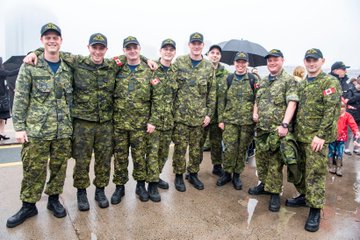
HALIFAX— Hundreds of people gathered on a jetty at Halifax’s naval base Wednesday to bid farewell to 240 military members aboard HMCS Ville de Quebec as it headed to the Mediterranean as part of Canada’s ongoing contribution to a NATO mission in central and eastern Europe.
Under pouring rain, family, friends and dignitaries waved goodbye as the warship sounded a fog horn and departed through a heavy mist in Halifax harbour.
Children in brightly-coloured rain boots waved Canadian flags and homemade signs, one saying, “Bye Mommy, see you later” while another said, “Bon Voyage Daddy.”
Couples shielded from the rain under large umbrellas hugged and kissed goodbye before the six-month mission.
“It’s overwhelming,” said Vanessa Picard, standing on the jetty with her two young children after her husband departed. She called the experience of watching him sail off “surreal.”
It’s a familiar scene here at HMC Dockyard Halifax, as the commanding officer of the warship noted.
“It’s really hard on families,” said Cmdr. Scott Robinson, adding he was leaving behind his wife and two young children. “I’m not the only one. It weighs on you.”
Several ships deploy from the east coast base every year, but the HMCS Ville de Quebec send off was a significant milestone for the Canadian military.
On board the frigate was a CH-148 Cyclone helicopter — the first international mission for the new twin-engine machine.
Defence Minister Harjit Sajjan said the state-of-the-art technology adds to the “tremendous capability” of the country’s armed forces and its contribution to Operation Reassurance.
The retired lieutenant-colonel also said it “sends a very strong message of deterrence” to countries like Russia, which he said is starting to go against “a rule-based order.”
Sajjan pointed to Russian actions under Vladimir Putin, such as the annexation of Crimea, its support for rebel forces in eastern Ukraine and Bashar al-Assad’s government in Syria.
“It’s something that we will not stand for,” he told reporters following the warship’s departure. “This is one of the reasons why Canada will continue to step up not only as part of NATO, but as part of a coalition.”
He added that Canada “will not take threats lightly” and that the multinational, “fully combat ready” battle groups send a strong message.
Indeed, the commander of the HMCS Ville de Quebec said he expects to run training exercises with his crew to “keep our combat capability at a high level in case the government calls upon us to react to some sort of world event,” Robinson said.
“We want to maintain our proficiency as much as we can at the highest level in case the government of Canada calls on us to do something.”
Meanwhile, the Royal Canadian Navy commander called it an “exciting moment” for the first-ever Cyclone helicopter to be sent on a mission.
Vice-Admiral Ron Lloyd said Canada’s contribution to the NATO mission will help “enhance regional maritime security and stability.”
The Halifax-class warship HMCS Ville de Quebec is slated to relieve HMCS St. John’s, which returns to Halifax later this month after a six-month mission.
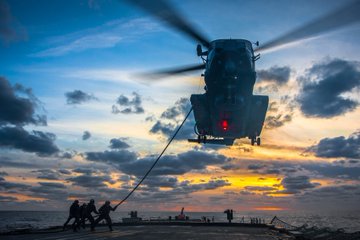
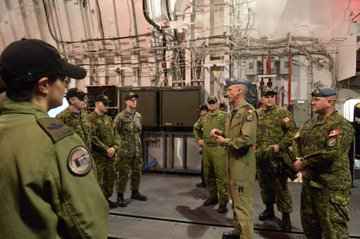
Today the first CH-148 Cyclone helicopter and aircrew embark aboard HMCS Ville de Québec for Op REASSURANCE, @CanadianForces support to #NATO defence and deterrence measures in Central and Eastern Europe.#RCAF #RCAFProud
The deployment of the Cyclone marks a major milestone for the 17-metre, 13,000-kilogram aircraft.
In January, the East Coast fleet of Sea Kings was retired after 54 years of service.
The Cyclone fleet will be tasked with surface and sub-surface surveillance, and search and rescue missions, while providing “tactical transport for national and international security efforts,” according to the military. Its aluminum and composite airframe is built with lightning-strike and high-intensity radio frequency pulse protection.
HALIFAX— Hundreds of people gathered on a jetty at Halifax’s naval base Wednesday to bid farewell to 240 military members aboard HMCS Ville de Quebec as it headed to the Mediterranean as part of Canada’s ongoing contribution to a NATO mission in central and eastern Europe.
Under pouring rain, family, friends and dignitaries waved goodbye as the warship sounded a fog horn and departed through a heavy mist in Halifax harbour.
/https://www.thestar.com/content/dam/thestar/halifax/2018/07/18/hundreds-gather-as-hmcs-ville-de-quebec-departs-halifax-with-new-cyclone-helicopter-aboard/_1_hmcs_ville_de_quebec.jpg) |
| HMCS Ville de Quebec in Halifax last December. Hundreds of people gathered on a jetty at Halifax's naval base today to bid farewell to 240 military members aboard the vessel. (ANDREW VAUGHAN / THE CANADIAN PRESS FILE PHOTO) |
/https://www.thestar.com/content/dam/thestar/halifax/2018/07/18/hundreds-gather-as-hmcs-ville-de-quebec-departs-halifax-with-new-cyclone-helicopter-aboard/_2_hmcs.jpg) |
| An RCAF CH-148 Cyclone maritime helicopter flies past a luxury yacht in Halifax on Friday, July 13, 2018. It departed for its first international deployment with the frigate HMCS Ville de Quebec today. (ANDREW VAUGHAN / THE CANADIAN PRESS) |
Couples shielded from the rain under large umbrellas hugged and kissed goodbye before the six-month mission.
“It’s overwhelming,” said Vanessa Picard, standing on the jetty with her two young children after her husband departed. She called the experience of watching him sail off “surreal.”
It’s a familiar scene here at HMC Dockyard Halifax, as the commanding officer of the warship noted.
“It’s really hard on families,” said Cmdr. Scott Robinson, adding he was leaving behind his wife and two young children. “I’m not the only one. It weighs on you.”
Several ships deploy from the east coast base every year, but the HMCS Ville de Quebec send off was a significant milestone for the Canadian military.
On board the frigate was a CH-148 Cyclone helicopter — the first international mission for the new twin-engine machine.
Defence Minister Harjit Sajjan said the state-of-the-art technology adds to the “tremendous capability” of the country’s armed forces and its contribution to Operation Reassurance.
The retired lieutenant-colonel also said it “sends a very strong message of deterrence” to countries like Russia, which he said is starting to go against “a rule-based order.”
Sajjan pointed to Russian actions under Vladimir Putin, such as the annexation of Crimea, its support for rebel forces in eastern Ukraine and Bashar al-Assad’s government in Syria.
“It’s something that we will not stand for,” he told reporters following the warship’s departure. “This is one of the reasons why Canada will continue to step up not only as part of NATO, but as part of a coalition.”
He added that Canada “will not take threats lightly” and that the multinational, “fully combat ready” battle groups send a strong message.
Indeed, the commander of the HMCS Ville de Quebec said he expects to run training exercises with his crew to “keep our combat capability at a high level in case the government calls upon us to react to some sort of world event,” Robinson said.
“We want to maintain our proficiency as much as we can at the highest level in case the government of Canada calls on us to do something.”
Meanwhile, the Royal Canadian Navy commander called it an “exciting moment” for the first-ever Cyclone helicopter to be sent on a mission.
Vice-Admiral Ron Lloyd said Canada’s contribution to the NATO mission will help “enhance regional maritime security and stability.”
The Halifax-class warship HMCS Ville de Quebec is slated to relieve HMCS St. John’s, which returns to Halifax later this month after a six-month mission.
Today the first CH-148 Cyclone helicopter and aircrew embark aboard HMCS Ville de Québec for Op REASSURANCE, @CanadianForces support to #NATO defence and deterrence measures in Central and Eastern Europe.#RCAF #RCAFProud
The deployment of the Cyclone marks a major milestone for the 17-metre, 13,000-kilogram aircraft.
In January, the East Coast fleet of Sea Kings was retired after 54 years of service.
The Cyclone fleet will be tasked with surface and sub-surface surveillance, and search and rescue missions, while providing “tactical transport for national and international security efforts,” according to the military. Its aluminum and composite airframe is built with lightning-strike and high-intensity radio frequency pulse protection.
Wednesday, July 18, 2018
TAPVs Well Suited for New Iraq Mission
By: David Pugliese, Defence Watch

Canadian military planners are currently going over options for the upcoming mission to Baghdad starting in the fall. The deployment includes a force protection group of about 125 personnel. They will provide on-site security for the NATO headquarters in the Iraqi capital city as well a mobile force protection group. The force will be outfitted with armoured vehicles for transportation, according to the Canadian government.
Defence Watch asked Defence Minister Harjit Sajjan’s office if LAV-llls were going to be sent. But Byrne Furlong, Sajjan’s press secretary, said no final decision has been made yet on the type of armoured platform troops will use.
One Department of National Defence official suggested that armoured SUVs could be used since the patrols will largely be in Baghdad.
Which raises the question- what about using the new Tactical Armoured Patrol Vehicle?
The vehicle is highly mobile and provides a very high degree of protection for its crew, according to the Canadian Army. It is not as big as the LAV-lll and could be better suited for an urban environment.
Furlong said more information on the composition of the mission and equipment it will use will be released at a later date.
While security is tight in Baghdad, there still attacks. The United Nations reported that 19 people were killed and 18 injured in various attacks in the city in June. In January, suicide bombers killed 38 people and injured more than 105 others
Subscribe to:
Posts (Atom)